Application
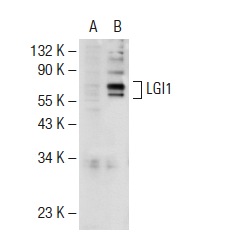
Western blot analysis of LGI1 expression in non-transfected: (A) and human LGI1 transfected: (B) 293T whole cell lysates.| Product Name | LGI1 Antibody (H-56) |
|---|---|
| Antibody Type | Primary Antibodies |
| Antigen Alias | epitope corresponding to amino acids 35-90 mapping near the N-terminus of LGI1 of human origin |
| Modification Notes | As human tumors progress to advanced stages, one genetic alteration that occurs at high frequency is a loss of heterozygosity (LOH) at chromosome 10. Mapping of homozygous deletions on this chromosome led to the isolation of the PTEN (also designated MMAC1 and TEP1), DMBT1 (for deleted in malignant brain tumors 1) and LGI1 (for leucine-rich gene-glioma inactivated 1) candidate tumor suppressor genes. The PTEN gene exhibits a high frequency of mutations in human glioblastomas and is also mutated in other cancers, including sporadic brain, breast, kidney and prostate cancers. Reduced levels of DMBT1 mRNA have been noted in gastrointestinal and esophageal cancers as well as in gliomas. LGI1, which is highly specific for neural tissues, shares homology with several transmembrane and extracellular proteins that function as receptors and adhesion proteins. |
| Clonality | Polyclonal |
|---|---|
| Isotype | IgG |
| Host Species | Rabbit |
| Tested Applications | WBIPIFELISA |
| recommended for detection of LGI1 of mouse, rat and human origin by WB, IP, IF and ELISA also reactive with additional species, including equine, canine, bovine and porcine: |
|
| Species Reactivity | HumanMouseRat |
| Concentration | 1mg/ml |
| Purification | Affinity purified |
| Alternative Names | epitope corresponding to amino acids 35-90 mapping near the N-terminus of LGI1 of human origin |
|---|---|
| Tissue Specificity | epitope corresponding to amino acids 35-90 mapping near the N-terminus of LGI1 of human origin |
| Entrez Gene | 9211 |
|---|
Application
Western blot analysis of LGI1 expression in non-transfected: (A) and human LGI1 transfected: (B) 293T whole cell lysates.| Application Notes | recommended for detection of LGI1 of mouse, rat and human origin by WB, IP, IF and ELISA also reactive with additional species, including equine, canine, bovine and porcine: |
|---|
| Form | Liquid |
|---|---|
| Storage Instructions | For short-term storage, store at 4° C. For long-term storage, aliquot and store at -20ºC or below. Avoid multiple freeze-thaw cycles. |
| Storage Buffer | phosphate buffered saline , pH 7.4, 150mM NaCl, 0.02% sodium azide and 50% glycerol. |


