Application
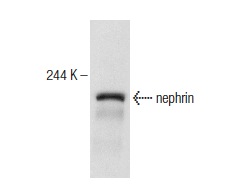
Western blot analysis of nephrin expression in human kidney tissue extract.| Product Name | nephrin Antibody (H-300) |
|---|---|
| Antibody Type | Primary Antibodies |
| Antigen Alias | epitope corresponding to amino acids 23-322 mapping within an extracellular domain of nephrin of human origin |
| Modification Notes | Nephrin is a member of the immunoglobulin family of cell adhesion molecules that localizes to opposing sites of the secondary foot processes formed by podocytes, a specialized epithelial cell that ensures size- and charge-selective ultrafiltration. The human nephrin gene maps to chromosome 19q13.1 and encodes a 1,241 amino acid protein that contains a transmembrane domain, eight Ig-like modules, and one fibronectin III-like module. Nephrin is expressed in embryonic and adult kidneys and localizes to glomerular podocytes and the glomerular slit diaphragm. Nephrin stimulates mitogen-activated protein kinases and is enhanced by podocin, which binds to the cytoplasmic tail of nephrin. A293 cells treated with Phorbol-12-myristate-13-acetate can upregulate nephrin, suggesting that protein kinase C is part of an intracellular signalling system, which regulates nephrin. |
| Clonality | Polyclonal |
|---|---|
| Isotype | IgG |
| Host Species | Rabbit |
| Tested Applications | WBIPIFELISA |
| recommended for detection of nephrin of mouse, rat and human origin by WB, IP, IF and ELISA also reactive with additional species, including canine and bovine: |
|
| Species Reactivity | HumanMouseRat |
| Concentration | 1mg/ml |
| Purification | Affinity purified |
| Alternative Names | epitope corresponding to amino acids 23-322 mapping within an extracellular domain of nephrin of human origin |
|---|---|
| Tissue Specificity | epitope corresponding to amino acids 23-322 mapping within an extracellular domain of nephrin of human origin |
| Entrez Gene | 4868 |
|---|
Application
Western blot analysis of nephrin expression in human kidney tissue extract.| Application Notes | recommended for detection of nephrin of mouse, rat and human origin by WB, IP, IF and ELISA also reactive with additional species, including canine and bovine: |
|---|
| Form | Liquid |
|---|---|
| Storage Instructions | For short-term storage, store at 4° C. For long-term storage, aliquot and store at -20ºC or below. Avoid multiple freeze-thaw cycles. |
| Storage Buffer | phosphate buffered saline , pH 7.4, 150mM NaCl, 0.02% sodium azide and 50% glycerol. |


