Application
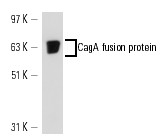
Western blot analysis of H. pylori recombinant CagA fusion protein.| Product Name | CagA Antibody (b-300) |
|---|---|
| Antibody Type | Primary Antibodies |
| Antigen Alias | epitope corresponding to amino acids 1-300 of CagA of H. pylori origin |
| Modification Notes | Helicobacter pylori is a spiral shaped bacterium that accounts for eighty percent of stomach ulcers and more than ninety percent of duodenal ulcers (1). Infection with H. pylori is also associated with the development of gastric cancer (1). The vacuolating toxin VacA is a major determinant of H. pylori-associated gastric disease (2,3). In non-polarized cells, VacA alters the endocytic pathway, resulting in the release of acid hydrolases and the reduction of both extracellular ligand degradation and antigen processing (2-4). The toxin forms trans-membrane anion-specific channels and reduces the transepithelial electrical resistance of polarized monolayers (2,3). Localization of the VacA channels in acidic intracellular compartments causes osmotic swelling; which, together with membrane fusion, leads to vacuole formation (2,3). This protein has recently been shown to be an important antigen in the human immune response to H. pylori infection (2-4). Cytotoxin associated gene A, otherwise known as CagA, is closely associated with that of VacA (4-6). CagA induces morphological changes in the host, as well as inducing actin reorganization, variations in the cell cycle and autocrine effects (4-6). |
| Clonality | Polyclonal |
|---|---|
| Isotype | IgG |
| Host Species | Rabbit |
| Tested Applications | WBIPELISA |
| recommended for detection of CagA of H. pylori origin by WB, IP and ELISA: |
|
| Species Reactivity | HumanMouseRat |
| Concentration | 1mg/ml |
| Purification | Affinity purified |
| Alternative Names | epitope corresponding to amino acids 1-300 of CagA of H. pylori origin |
|---|---|
| Tissue Specificity | epitope corresponding to amino acids 1-300 of CagA of H. pylori origin |
Application
Western blot analysis of H. pylori recombinant CagA fusion protein.| Application Notes | recommended for detection of CagA of H. pylori origin by WB, IP and ELISA: |
|---|
| Form | Liquid |
|---|---|
| Storage Instructions | For short-term storage, store at 4° C. For long-term storage, aliquot and store at -20ºC or below. Avoid multiple freeze-thaw cycles. |
| Storage Buffer | phosphate buffered saline , pH 7.4, 150mM NaCl, 0.02% sodium azide and 50% glycerol. |


