Application
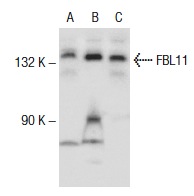
Western blot analysis of FBL11 expression in HeLa (A), IMR-32 (B) and SH-SY5Y (C) nuclear extracts.| Product Name | FBL11 Antibody (H-120) |
|---|---|
| Antibody Type | Primary Antibodies |
| Antigen Alias | epitope corresponding to amino acids 351-470 mapping within an internal region of FBL11 of human origin |
| Modification Notes | F-box proteins are critical components of the SCF (Skp1-CUL-1-F-box protein) type E3 ubiquitin ligase complex and are involved in substrate recognition and protein recruitment. F-box proteins are members of a large family that regulate the cell cycle, immune response, signaling cascades and developmental programs by targeting proteins, such as cyclins, for degradation by the proteasome after ubiquitination. FBL11, also known as FBXL11 (F-box and leucine-rich repeat protein 11), CXXC8, KDM2A, JHDM1A (JmjC domain-containing histone demethylation protein 1A) or LILINA, is a 1,162 amino acid member of the F-box protein family that contains one F-box domain and localizes to the nucleus. Expressed ubiquitously with highest expression in testis, ovary and brain, FBL11 functions to demethylate the Lys-36 residue of histone H3, thereby modulating the histone code. Additionally, FBL11 is thought to promote the ubiquitination and subsequent degradation of various phosphorylated proteins. Three isoforms of FBL11 exist due to alternative splicing events. |
| Clonality | Polyclonal |
|---|---|
| Isotype | IgG |
| Host Species | Rabbit |
| Tested Applications | WBIPIFELISA |
| recommended for detection of FBL11 of mouse, rat and human origin by WB, IP, IF and ELISA also reactive with additional species, including equine, canine, bovine and porcine: |
|
| Species Reactivity | HumanMouseRat |
| Concentration | 1mg/ml |
| Purification | Affinity purified |
| Alternative Names | epitope corresponding to amino acids 351-470 mapping within an internal region of FBL11 of human origin |
|---|---|
| Tissue Specificity | epitope corresponding to amino acids 351-470 mapping within an internal region of FBL11 of human origin |
Application
Western blot analysis of FBL11 expression in HeLa (A), IMR-32 (B) and SH-SY5Y (C) nuclear extracts.| Application Notes | recommended for detection of FBL11 of mouse, rat and human origin by WB, IP, IF and ELISA also reactive with additional species, including equine, canine, bovine and porcine: |
|---|
| Form | Liquid |
|---|---|
| Storage Instructions | For short-term storage, store at 4° C. For long-term storage, aliquot and store at -20ºC or below. Avoid multiple freeze-thaw cycles. |
| Storage Buffer | phosphate buffered saline , pH 7.4, 150mM NaCl, 0.02% sodium azide and 50% glycerol. |


