Application
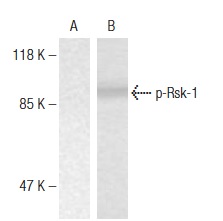
Western blot analysis of phosphorylated Rsk-1 expression in untreated (A) and Insulin-treated (B) HUVEC cell extracts.| Product Name | p-Rsk-1 Antibody (Ser 363) |
|---|---|
| Antibody Type | Primary Antibodies |
| Antigen Alias | recommended for detection of Ser 363 phosphorylated Rsk-1 of human and rat origin and correspondingly phosphorylated Ser 352 of mouse origin of mouse, rat and human origin by WB and IP |
| Modification | Phosphoralated |
| Modification Notes | The family of ribosomal S6 kinases (Rsks), designated Rsk-1, Rsk-2 and Rsk-3, are important signaling intermediates that mediate responses to a broad range of ligand-activated receptor tyrosine kinases. It has been established that Rsk-3 is not activated by MAP kinase in vitro, unlike Rsk-1 and Rsk-2. A unique feature common to the three members of the Rsk family is that each possesses two non-identical complete kinase catalytic domains. The Rsk family amino-terminal kinase domain is phosphorylated on Ser 227 by 3-phosphoinositide-dependent protein kinase-1 (PDK1), which increases the kinase activity of Rsk. In the carboxy-terminal kinase domain, Rsk-1 and Rsk-2 are autophosphorylated on Ser 380 and Ser 386, respectively, which mediates the docking of PDK1 to Rsk in order to promote phosphorylation of substrates, such as histone H3. Human, rat and mouse Rsk-1 are activated by phosphorylation on threonine and serine residues, such as Ser 363. |
| Clonality | Polyclonal |
|---|---|
| Isotype | IgG |
| Host Species | Rabbit |
| Tested Applications | WB |
| WB:1:500~1:2000 Notes:Optimal dilutions/concentrations should be determined by the researcher. |
|
| Species Reactivity | HumanMouseRat |
| Concentration | 1mg/ml |
| Purification | Affinity purified |
| Alternative Names | recommended for detection of Ser 363 phosphorylated Rsk-1 of human and rat origin and correspondingly phosphorylated Ser 352 of mouse origin of mouse rat and human origin by WB and IP |
|---|---|
| Tissue Specificity | recommended for detection of Ser 363 phosphorylated Rsk-1 of human and rat origin and correspondingly phosphorylated Ser 352 of mouse origin of mouse, rat and human origin by WB and IP |
| Entrez Gene | 6195 |
|---|
Application
Western blot analysis of phosphorylated Rsk-1 expression in untreated (A) and Insulin-treated (B) HUVEC cell extracts.| Application Notes | WB:1:500~1:2000 Notes:Optimal dilutions/concentrations should be determined by the researcher. |
|---|
| Form | Liquid |
|---|---|
| Storage Instructions | For short-term storage, store at 4° C. For long-term storage, aliquot and store at -20ºC or below. Avoid multiple freeze-thaw cycles. |
| Storage Buffer | phosphate buffered saline , pH 7.4, 150mM NaCl, 0.02% sodium azide and 50% glycerol. |


