Application
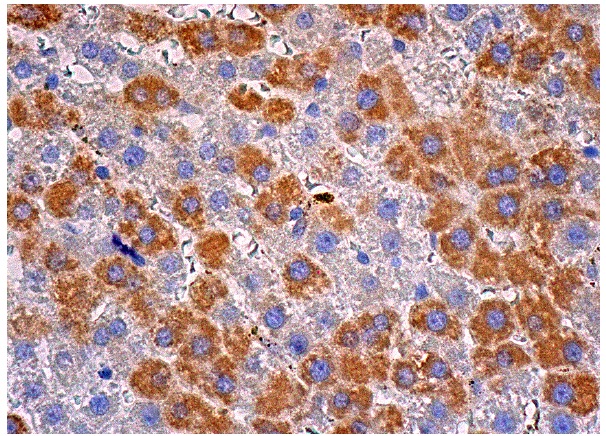
Immunoperoxidase staining of formalin fixed, paraffin-embedded human liver tissue showing cytoplasmic staining of hepatocytes.| Product Name | β-Gal Antibody (H-80) |
|---|---|
| Antibody Type | Primary Antibodies |
| Antigen Alias | epitope corresponding to amino acids 496-575 mapping near the C-terminus of β-galactosidase of human origin |
| Modification Notes | The human b-galactosidase gene, known as the LacZ gene, maps to chromosome 3p21.33 and encodes a 677 amino acid protein with an optimum functional pH range of 6 to 8. Catalytically active b-galactosidaseis (b-Gal) is a tetramer of four identical subunits, each with an active site, which can independently catalyze the cleavage of terminal galactose. Monovalent cations have a stimulatory effect on the enzymatic reaction, which likely involves a galactosyl-enzyme complex intermediate. b-Gals are widespread in animals, microorganisms and plants. The LacZ gene is widely used as a reporter gene with a variety of colored or fluorescent compounds capable of being produced from appropriate substrates, such as Xgal, which produces a blue color. For this reason, LacZ is incorporated into numerous plasmid vectors as a marker. |
| Clonality | Polyclonal |
|---|---|
| Isotype | IgG |
| Host Species | Rabbit |
| Tested Applications | WBIPIFIHCELISA |
| recommended for detection of β-Gal of human origin by WB, IP, IF, IHC(P) and ELISA: |
|
| Species Reactivity | HumanMouseRat |
| Concentration | 1mg/ml |
| Purification | Affinity purified |
| Alternative Names | epitope corresponding to amino acids 496-575 mapping near the C-terminus of &beta -galactosidase of human origin |
|---|---|
| Tissue Specificity | epitope corresponding to amino acids 496-575 mapping near the C-terminus of β-galactosidase of human origin |
| Entrez Gene | 2720 |
|---|
Application
Immunoperoxidase staining of formalin fixed, paraffin-embedded human liver tissue showing cytoplasmic staining of hepatocytes.| Application Notes | recommended for detection of β-Gal of human origin by WB, IP, IF, IHC(P) and ELISA: |
|---|
| Form | Liquid |
|---|---|
| Storage Instructions | For short-term storage, store at 4° C. For long-term storage, aliquot and store at -20ºC or below. Avoid multiple freeze-thaw cycles. |
| Storage Buffer | phosphate buffered saline , pH 7.4, 150mM NaCl, 0.02% sodium azide and 50% glycerol. |


