Application
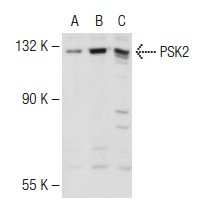
Western blot analysis of PSK2 expression in non-transfected 293T: (A), mouse PSK2 transfected 293T: (B) and HeLa (C) whole cell lysates.Application
Western blot analysis of PSK2 expression in mouse brain tissue extract.| Product Name | PSK2 Antibody (T-25) |
|---|---|
| Antibody Type | Primary Antibodies |
| Antigen Alias | recommended for detection of PSK2 of mouse and human origin by WB, IP and ELISA |
| Modification Notes | The phosphorylation and dephosphorylation of proteins on serine and threonine residues is an essential means of regulating a broad range of cellular functions in eukaryotes, including cell division, homeostasis and apoptosis. A group of proteins that are intimately involved in this process are the serine/threonine (Ser/Thr) protein kinases. PSK2 (Prostate-derived STE20-like kinase 2), also known as TAOK1 (TAO kinase 1), TAO1 (thousand and one amino acid protein 1), hKFC-B (kinase from chicken homolog B), MARKK or MAP3K16, is a member of the Ser/Thr protein kinase family and belongs to the GCK-like class of STE20-like kinases. Expressed at high levels in testis and at lower levels in placenta, colon, brain and skeletal muscle, PSK2 localizes to the cytoplasm and phosphorylates MEK-3, thereby activating the p38 MAP kinase pathway. In addition, PSK2 is capable of activating JNK and inducing JNK-dependent morphological changes that lead to apoptosis. Upon activation of caspases, PSK2 is cleaved by caspase-3. |
| Clonality | Polyclonal |
|---|---|
| Isotype | IgG |
| Host Species | Rabbit |
| Tested Applications | WBIPELISA |
| WB:1:500~1:2000 IP:1:100~1:500 Notes:Optimal dilutions/concentrations should be determined by the researcher. |
|
| Species Reactivity | HumanMouseRat |
| Concentration | 1mg/ml |
| Purification | Affinity purified |
| Alternative Names | recommended for detection of PSK2 of mouse and human origin by WB IP and ELISA |
|---|---|
| Tissue Specificity | recommended for detection of PSK2 of mouse and human origin by WB, IP and ELISA |
| Entrez Gene | 57551 |
|---|
Application
Western blot analysis of PSK2 expression in non-transfected 293T: (A), mouse PSK2 transfected 293T: (B) and HeLa (C) whole cell lysates.
Application
Western blot analysis of PSK2 expression in mouse brain tissue extract.| Application Notes | WB:1:500~1:2000 IP:1:100~1:500 Notes:Optimal dilutions/concentrations should be determined by the researcher. |
|---|
| Form | Liquid |
|---|---|
| Storage Instructions | For short-term storage, store at 4° C. For long-term storage, aliquot and store at -20ºC or below. Avoid multiple freeze-thaw cycles. |
| Storage Buffer | phosphate buffered saline , pH 7.4, 150mM NaCl, 0.02% sodium azide and 50% glycerol. |


