Application
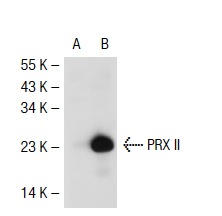
Western blot analysis of PRX II expression in non-transfected: (A) and mouse PRX II transfected: (B) 293T whole cell lysates.Application
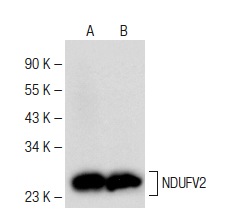
Western blot analysis of PRX II expression in non-transfected: (A) and human PRX II transfected: (B)293T whole cell lysates.Application
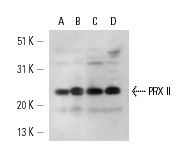
Western blot analysis of PRX II expression in SK-BR-3 (A), SK-N-SH (B), MDA-MB-231 (C) and MCF7 (D) whole cell lysates.| Product Name | PRX II Antibody (M-40) |
|---|---|
| Antibody Type | Primary Antibodies |
| Antigen Alias | epitope corresponding to amino acids 1-40 mapping at the N-terminus of PRX II of mouse origin |
| Modification Notes | The peroxiredoxin (PRX) family comprises six antioxidant proteins, PRX I, II, III, IV, V and VI, which protect cells from reactive oxygen species (ROS) by preventing the metal-catalyzed oxidation of enzymes. The PRX proteins primarily utilize thioredoxin as the electron donor for antioxidation, although they are fairly promiscuous with regard to the hydroperoxide substrate. In addition to protection from ROS, peroxiredoxins are also involved in cell proliferation, differentiation and gene expression. PRX I, II, IV and VI show diffuse cytoplasmic localization, while PRX III and V exhibit distinct mitochondrial localization. The human PRX I gene encodes a protein that is expressed in several tissues, including liver, kidney, testis, lung and nervous system. PRX II is expressed in testis, while PRX III shows expression in lung. PRX I, II and III are overexpressed in breast cancer and may be involved in its development or progression. Upregulated protein levels of PRX I and II in Alzheimer’s disease (AD) and Down syndrome (DS) indicate the involvement of PRX I and II in their pathogenesis. The human PRX IV gene is abundantly expressed in many tissues. PRX IV exists as a precursor protein, which is only detected in testis, and a processed secreted form. PRX V also exists as two forms, designated long and short. Like PRX IV, the long form of PRX V is highly expressed in testis. The short form of PRX V is more widely expressed, with high expression in liver, kidney, heart and lung. PRX VI, a 1-Cys peroxiredoxin (also known as antioxidant protein 2 or AOP2), is highly expressed in most tissues, particularly in epithelial cells. Localized to the cell cytosol, PRX VI functions independently of other peroxiredoxins and antioxidant proteins, specializing in antioxidant defense, lung phospholipid metabolism and protection of keratinocytes from cell death induced by reactive oxygen species. |
| Clonality | Polyclonal |
|---|---|
| Isotype | IgG |
| Host Species | Rabbit |
| Tested Applications | WBIPIFELISA |
| recommended for detection of PRX II and, to a lesser extent, Prx I of mouse, rat and human origin by WB, IP, IF and ELISA: |
|
| Species Reactivity | HumanMouseRat |
| Concentration | 1mg/ml |
| Purification | Affinity purified |
| Alternative Names | epitope corresponding to amino acids 1-40 mapping at the N-terminus of PRX II of mouse origin |
|---|---|
| Tissue Specificity | epitope corresponding to amino acids 1-40 mapping at the N-terminus of PRX II of mouse origin |
| Entrez Gene | 7001 |
|---|
Application
Western blot analysis of PRX II expression in non-transfected: (A) and mouse PRX II transfected: (B) 293T whole cell lysates.
Application
Western blot analysis of PRX II expression in non-transfected: (A) and human PRX II transfected: (B)293T whole cell lysates.
Application
Western blot analysis of PRX II expression in SK-BR-3 (A), SK-N-SH (B), MDA-MB-231 (C) and MCF7 (D) whole cell lysates.| Application Notes | recommended for detection of PRX II and, to a lesser extent, Prx I of mouse, rat and human origin by WB, IP, IF and ELISA: |
|---|
| Form | Liquid |
|---|---|
| Storage Instructions | For short-term storage, store at 4° C. For long-term storage, aliquot and store at -20ºC or below. Avoid multiple freeze-thaw cycles. |
| Storage Buffer | phosphate buffered saline , pH 7.4, 150mM NaCl, 0.02% sodium azide and 50% glycerol. |


