Application
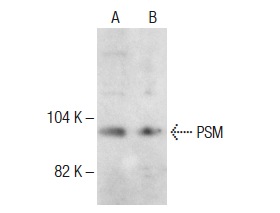
Western blot analysis of PSM expression in Jurkat (A) and LNCaP (B) whole cell lysates.| Product Name | PSM Antibody (H-60) |
|---|---|
| Antibody Type | Primary Antibodies |
| Antigen Alias | epitope corresponding to amino acids 568-627 of PSM of human origin |
| Modification Notes | Prostate cancer is the most frequently diagnosed cancer and the early detection of prostate cancer dramatically and efficiently reduces the observed mortality rate. Several proteins have been identified as specific markers of prostate cancer, and they may be useful as diagnostic indicators. PSA, prostate specific antigen, is the classical indicator for transformed prostate tissue; however, in addition to being upregulated in prostate cancer, PSA is also upregulated in non-malignant conditions, such as benign prostatic hyperplasia prostate. Conversely, STEAP (six-transmembrane epithelial antigen of the prostate), prostate carcinoma tumor antigen (PCTA-1) and prostate-specific membrane antigen (PSM) represent additional prostate-specific antigens that are overexpressed only in malignant tumors and therefore are more specific identifiers of malignancies. PSM is an integral membrane protein, and PCTA-1 is related to the galectin gene family, which mediate both cell-cell and cell-matrix interactions in a manner similar to the selectin subgroup of C-type lectins. STEAP is a serpentine transmembrane cell-surface tumor-antigen that is predicted to functions as a channel or transporter protein. In addition to prostate cancers, STEAP is also upregulated in bladder, colon and ovarian cancers. |
| Clonality | Polyclonal |
|---|---|
| Isotype | IgG |
| Host Species | Rabbit |
| Tested Applications | WBIPIFELISA |
| recommended for detection of PSM of mouse, rat and human origin by WB, IP, IF and ELISA also reactive with additional species, including equine, canine and bovine: |
|
| Species Reactivity | HumanMouseRat |
| Concentration | 1mg/ml |
| Purification | Affinity purified |
| Alternative Names | epitope corresponding to amino acids 568-627 of PSM of human origin |
|---|---|
| Tissue Specificity | epitope corresponding to amino acids 568-627 of PSM of human origin |
| Entrez Gene | 2346 |
|---|
Application
Western blot analysis of PSM expression in Jurkat (A) and LNCaP (B) whole cell lysates.| Application Notes | recommended for detection of PSM of mouse, rat and human origin by WB, IP, IF and ELISA also reactive with additional species, including equine, canine and bovine: |
|---|
| Form | Liquid |
|---|---|
| Storage Instructions | For short-term storage, store at 4° C. For long-term storage, aliquot and store at -20ºC or below. Avoid multiple freeze-thaw cycles. |
| Storage Buffer | phosphate buffered saline , pH 7.4, 150mM NaCl, 0.02% sodium azide and 50% glycerol. |


