Application
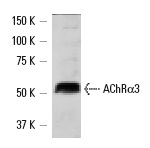
Western blot analysis of AChRα3 expression in mouse brain tissue extract.| Product Name | AChRα3 Antibody (H-100) |
|---|---|
| Antibody Type | Primary Antibodies |
| Antigen Alias | epitope corresponding to amino acids 346-445 of acetylcholine receptor alpha 3 subunit of human origin |
| Modification Notes | Members of the ligand-gated ion channel receptor family are characterized by their fast transmitting response to neurotransmitters. Two important members of this family are the nicotinic acetylcholine and glutamate receptors, both of which are composed of five homologous subunits forming a transmembrane aqueous pore. These transmembrane receptors change conformation in response to their cognate neurotransmitter. Nicotinic acetylcholine receptors (AChRs) are found at the postsynaptic membrane of the neuromuscular junction and bind acetylcholine molecules, allowing ions to move through the pore. Glutamate receptors are found in the postsynaptic membrane of cells in the central nervous system. The activity that is generated at the synapse by the binding of acetylcholine is terminated by acetylcholinesterase, an enzyme that rapidly hydrolyzes acetylcholine. AChRå3, also known as LNCR2, PAOD2, NACHRA3 or CHRNA3, is a 505 amino acid multi-pass membrane protein that belongs to the ligand-gated ion channel receptor family and may play a role in neurotransmission. |
| Clonality | Polyclonal |
|---|---|
| Isotype | IgG |
| Host Species | Rabbit |
| Tested Applications | WBIPIFELISA |
| recommended for detection of AChRα3 of mouse, rat and human origin by WB, IP, IF and ELISA also reactive with additional species, including equine, bovine and porcine: |
|
| Species Reactivity | HumanMouseRat |
| Concentration | 1mg/ml |
| Purification | Affinity purified |
| Alternative Names | epitope corresponding to amino acids 346-445 of acetylcholine receptor alpha 3 subunit of human origin |
|---|---|
| Tissue Specificity | epitope corresponding to amino acids 346-445 of acetylcholine receptor alpha 3 subunit of human origin |
| Entrez Gene | 1136 |
|---|
Application
Western blot analysis of AChRα3 expression in mouse brain tissue extract.| Application Notes | recommended for detection of AChRα3 of mouse, rat and human origin by WB, IP, IF and ELISA also reactive with additional species, including equine, bovine and porcine: |
|---|
| Form | Liquid |
|---|---|
| Storage Instructions | For short-term storage, store at 4° C. For long-term storage, aliquot and store at -20ºC or below. Avoid multiple freeze-thaw cycles. |
| Storage Buffer | phosphate buffered saline , pH 7.4, 150mM NaCl, 0.02% sodium azide and 50% glycerol. |


