Application
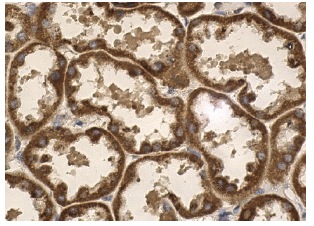
Immunoperoxidase staining of formalin fixed, paraffin-embedded human kidney tissue showing cytoplasmic staining of cells in tubules.Application
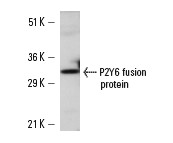
Western blot analysis of human recombinant P2Y6 fusion protein.| Product Name | P2Y6 Antibody (H-70) |
|---|---|
| Antibody Type | Primary Antibodies |
| Antigen Alias | epitope corresponding to amino acids 1-70 mapping at the N-terminus of P2Y6 of human origin |
| Modification Notes | Nucleotides are emerging as important extracellular signaling molecules that mediate several effects, such as proliferation, differentiation, chemotaxis and cytokine release. The P2 receptor family is activated by the binding of nucleotides and is divided into two subfamilies, P2X and P2Y. The P2X receptor family is comprised of ligand-gated ion channels that allow for the increased permeability of calcium into the cell in response to extracellular ATP. The P2Y receptor family are G protein-coupled receptors which mediate the effects of extracellular nucleotides, primarily through the activation of phospholipase C. To some extent, the P2Y receptors can also activate potassium channels or, alternatively, inhibit adenylate cyclase and N-type calcium channels in response to extracellular nucleotides. The P2Y receptors are differentially expressed in several tissue types, such as heart, lung and brain. However, all P2Y receptors are expressed in leukocytes, which suggests a role for the P2Y receptor family in the activation of leukocytes and platelets in response to inflammation or vascular damage. |
| Clonality | Polyclonal |
|---|---|
| Isotype | IgG |
| Host Species | Rabbit |
| Tested Applications | WBIPIFIHCELISA |
| recommended for detection of P2Y6 of human and, to a lesser extent, mouse and rat origin by WB, IP, IF, IHC(P) and ELISA also reactive with additional species, including canine, bovine and porcine: |
|
| Species Reactivity | HumanMouseRat |
| Concentration | 1mg/ml |
| Purification | Affinity purified |
| Alternative Names | epitope corresponding to amino acids 1-70 mapping at the N-terminus of P2Y6 of human origin |
|---|---|
| Tissue Specificity | epitope corresponding to amino acids 1-70 mapping at the N-terminus of P2Y6 of human origin |
| Entrez Gene | 5031 |
|---|
Application
Immunoperoxidase staining of formalin fixed, paraffin-embedded human kidney tissue showing cytoplasmic staining of cells in tubules.
Application
Western blot analysis of human recombinant P2Y6 fusion protein.| Application Notes | recommended for detection of P2Y6 of human and, to a lesser extent, mouse and rat origin by WB, IP, IF, IHC(P) and ELISA also reactive with additional species, including canine, bovine and porcine: |
|---|
| Form | Liquid |
|---|---|
| Storage Instructions | For short-term storage, store at 4° C. For long-term storage, aliquot and store at -20ºC or below. Avoid multiple freeze-thaw cycles. |
| Storage Buffer | phosphate buffered saline , pH 7.4, 150mM NaCl, 0.02% sodium azide and 50% glycerol. |


