Application
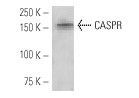
Western blot analysis of CASPR expression in mouse brain tissue extract.| Product Name | CASPR Antibody (H-66) |
|---|---|
| Antibody Type | Primary Antibodies |
| Antigen Alias | epitope corresponding to amino acids 1251-1316 mapping near the C-terminus of CASPR of human origin |
| Modification Notes | Neurexins comprise a family of neuronal cell surface proteins, which include neurexin I (NRXN1), neurexin II (NRXN2), neurexin III (NRXN3) and CASPR (neurexin IV). Neurexins I-III are expressed as å and ∫ isoforms. The å isoforms are made of three cassettes, which contain two LNS (laminin A, neurexins, sex hormone-binding)-domains separated by EGF domains, followed by a transmembrane region and a 55 amino acid cytoplasmic C-terminal. The å isoforms bind to neurexophilins at the second LNS site, and to the excitatory neurotoxin å-latrotoxin. The ∫ isoforms have only one LNS-domain, bind to neuroligins and play a role in the formation and remodeling of synapses. CASPR (for contactin-associated protein 1, also designated paranodin in mouse), contains an extracellular domain similar to the other three neurexins, and binds to the surface glycoprotein contactin. CASPR and the closely related CASPR2, a mammalian homolog of Drosophila neurexin IV (Nrx-IV), demarcate distinct subdomains in myelinated axons. Specifically, CASPR exists at the paranodal junctions, while CASPR2 co-localizes with Shaker-like K+ channels in the juxtaparanodal region. CASPR may play a role in the communication of glial cells and neurons during development. |
| Clonality | Polyclonal |
|---|---|
| Isotype | IgG |
| Host Species | Rabbit |
| Tested Applications | WBIPIFELISA |
| recommended for detection of CASPR of mouse, rat and human origin by WB, IP, IF and ELISA also reactive with additional species, including equine and canine: |
|
| Species Reactivity | HumanMouseRat |
| Concentration | 1mg/ml |
| Purification | Affinity purified |
| Alternative Names | epitope corresponding to amino acids 1251-1316 mapping near the C-terminus of CASPR of human origin |
|---|---|
| Tissue Specificity | epitope corresponding to amino acids 1251-1316 mapping near the C-terminus of CASPR of human origin |
| Entrez Gene | 8506 |
|---|
Application
Western blot analysis of CASPR expression in mouse brain tissue extract.| Application Notes | recommended for detection of CASPR of mouse, rat and human origin by WB, IP, IF and ELISA also reactive with additional species, including equine and canine: |
|---|
| Form | Liquid |
|---|---|
| Storage Instructions | For short-term storage, store at 4° C. For long-term storage, aliquot and store at -20ºC or below. Avoid multiple freeze-thaw cycles. |
| Storage Buffer | phosphate buffered saline , pH 7.4, 150mM NaCl, 0.02% sodium azide and 50% glycerol. |


