Application
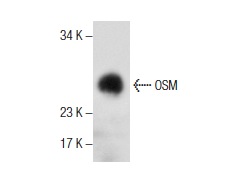
Western blot analysis of OSM expression in rat small intestine tissue extract.| Product Name | OSM Antibody (R-200) |
|---|---|
| Antibody Type | Primary Antibodies |
| Antigen Alias | epitope corresponding to amino acids 21-220 mapping representing mature of OSM of rat origin |
| Modification Notes | Oncostatin M (OSM) is a glycoprotein that was originally isolated from the conditioned medium of U937 human histiocytic leukemia cells that had been induced to differentiate into macrophage-like cells by treatment with phorbol 12-myristate 13 acetate. OSM inhibits the growth of a broad range of human tumor cell lines, but does not influence the growth of normal human fibroblasts. High-affinity binding sites for OSM have been detected on normal and tumor cells, and a receptor has been identified by chemical cross-linking studies. Expression of OSM is greatest in activated monocytic and lymphocytic cell lines and in normal adherent macrophages. Amino acid sequence analysis of OSM has revealed homology with leukemia inhibitory factor (LIF), granulocyte colony stimulating factor (G-CSF) and interleukin 6 (IL-6), all of which affect the growth and differentiation of a broad range of cell types, including those of hematopoietic origin. |
| Clonality | Polyclonal |
|---|---|
| Isotype | IgG |
| Host Species | Rabbit |
| Tested Applications | WBIPIFELISA |
| recommended for detection of oncostatin M of rat origin by WB, IP, IF and ELISA: |
|
| Species Reactivity | HumanMouseRat |
| Concentration | 1mg/ml |
| Purification | Affinity purified |
| Alternative Names | epitope corresponding to amino acids 21-220 mapping representing mature of OSM of rat origin |
|---|---|
| Tissue Specificity | epitope corresponding to amino acids 21-220 mapping representing mature of OSM of rat origin |
Application
Western blot analysis of OSM expression in rat small intestine tissue extract.| Application Notes | recommended for detection of oncostatin M of rat origin by WB, IP, IF and ELISA: |
|---|
| Form | Liquid |
|---|---|
| Storage Instructions | For short-term storage, store at 4° C. For long-term storage, aliquot and store at -20ºC or below. Avoid multiple freeze-thaw cycles. |
| Storage Buffer | phosphate buffered saline , pH 7.4, 150mM NaCl, 0.02% sodium azide and 50% glycerol. |


