Application
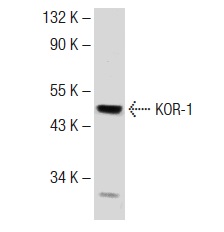
Western blot analysis of KOR-1 expression in AT-3 whole cell lysate.| Product Name | KOR-1 Antibody (H-70) |
|---|---|
| Antibody Type | Primary Antibodies |
| Antigen Alias | epitope corresponding to amino acids 1-70 mapping at the N-terminus of κ-type opioid receptor-1 (KOR-1) of human origin |
| Modification Notes | Endogenous opioid peptides and opiates, like morphine, transmit their pharmacological effects through membrane bound opioid receptors. Pharmacological studies and molecular cloning have led to the identification of three different types of opioid receptor, mu-type, delta-type and kappa-type, also designated MOR-1, DOR-1 and KOR-1, respectively. MOR-1 is a receptor for beta-endorphin, DOR-1 is a receptor for enkephalins, and KOR-1 is a receptor for dynorphins. The three opioid receptor types are highly homologous and belong to the superfamily of G-protein-coupled receptors. Opioid receptors have been shown to modulate a range of brain functions, including instinctive behavior and emotions. This regulation is thought to involve the inhibition of neurotransmitter release by reducing calcium ion currents and increasing potassium ion conductance. |
| Clonality | Polyclonal |
|---|---|
| Isotype | IgG |
| Host Species | Rabbit |
| Tested Applications | WBIPIFELISA |
| recommended for detection of KOR-1 of mouse, rat and human origin by WB, IP, IF and ELISA: |
|
| Species Reactivity | HumanMouseRat |
| Concentration | 1mg/ml |
| Purification | Affinity purified |
| Alternative Names | epitope corresponding to amino acids 1-70 mapping at the N-terminus of &kappa -type opioid receptor-1 (KOR-1) of human origin |
|---|---|
| Tissue Specificity | epitope corresponding to amino acids 1-70 mapping at the N-terminus of κ-type opioid receptor-1 (KOR-1) of human origin |
| Entrez Gene | 4986 |
|---|
Application
Western blot analysis of KOR-1 expression in AT-3 whole cell lysate.| Application Notes | recommended for detection of KOR-1 of mouse, rat and human origin by WB, IP, IF and ELISA: |
|---|
| Form | Liquid |
|---|---|
| Storage Instructions | For short-term storage, store at 4° C. For long-term storage, aliquot and store at -20ºC or below. Avoid multiple freeze-thaw cycles. |
| Storage Buffer | phosphate buffered saline , pH 7.4, 150mM NaCl, 0.02% sodium azide and 50% glycerol. |


