Application
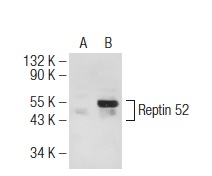
Western blot analysis of Reptin 52 expression in non-transfected: (A) and human Reptin 52 transfected: (B) 293T whole cell lysates.| Product Name | Reptin 52 Antibody (H-162) |
|---|---|
| Antibody Type | Primary Antibodies |
| Antigen Alias | epitope corresponding to amino acids 134-295 mapping within an internal region of Reptin 52 of human origin |
| Modification Notes | Pontin 52 is a nuclear matrix protein that is primarily expressed in the nucleus and is also present in the cytoplasm. It is expressed in the nucleoplasm of whole cells, but is not present in the nucleoli. Pontin 52, also designated RUVBL1 for E. coli RuvB-like 1 protein or NMP 238, is the human homolog of rat TIP49. Pontin 52 contains an ATPase/helicase motif and may represent a class of cofactors recruited by transcriptional activation domains that function in diverse pathways. For instance, in vivo, Pontin 52 is complexed with Myc and Reptin 52, which is a Pontin 52-related protein, also designated RUVBL2. The interaction of Pontin 52 with Myc is dependent upon a Myc domain essential for oncogenic activity, suggesting that functional Pontin 52 is an essential mediator of Myc oncogenic transformation. |
| Clonality | Polyclonal |
|---|---|
| Isotype | IgG |
| Host Species | Rabbit |
| Tested Applications | WBIPIFELISA |
| recommended for detection of Reptin 52 of mouse, rat and human origin by WB, IP, IF and ELISA also reactive with additional species, including equine, canine, bovine and porcine: |
|
| Species Reactivity | HumanMouseRat |
| Concentration | 1mg/ml |
| Purification | Affinity purified |
| Alternative Names | epitope corresponding to amino acids 134-295 mapping within an internal region of Reptin 52 of human origin |
|---|---|
| Tissue Specificity | epitope corresponding to amino acids 134-295 mapping within an internal region of Reptin 52 of human origin |
| Entrez Gene | 10856 |
|---|
Application
Western blot analysis of Reptin 52 expression in non-transfected: (A) and human Reptin 52 transfected: (B) 293T whole cell lysates.| Application Notes | recommended for detection of Reptin 52 of mouse, rat and human origin by WB, IP, IF and ELISA also reactive with additional species, including equine, canine, bovine and porcine: |
|---|
| Form | Liquid |
|---|---|
| Storage Instructions | For short-term storage, store at 4° C. For long-term storage, aliquot and store at -20ºC or below. Avoid multiple freeze-thaw cycles. |
| Storage Buffer | phosphate buffered saline , pH 7.4, 150mM NaCl, 0.02% sodium azide and 50% glycerol. |


