Application
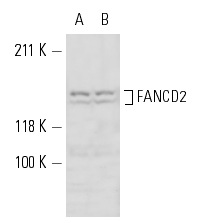
Western blot analysis of FANCD2 expression in HeLa (A) and MCF7 (B) nuclear extracts.Application
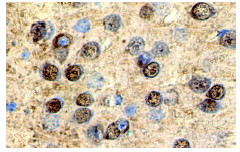
Immunoperoxidase staining of formalin fixed, paraffin-embedded mouse brain tissue showing nuclear localization in select cells.| Product Name | FANCD2 Antibody (H-300) |
|---|---|
| Antibody Type | Primary Antibodies |
| Antigen Alias | raised against amino acids 1172-1471 mapping at the C-terminus of FANCD2 of human origin |
| Modification Notes | Fanconi anemia (FA) is an autosomal recessive disorder character-ized by bone marrow failure, birth defects and chromosomal instability (1-7). At the cellular level, FA is characterized by spontaneous chromosomal breakage and a unique hypersensitivity to DNA cross-linking agents (1). At least 8 complementation groups (A-G) have been identified and 6 FA genes (for subtypes A, C, D2, E, F and G) have been cloned (2). The FA proteins lack sequence homologies or motifs that could point to a molecular function (1). Phosphorylation of FANC (Fanconi anemia complementation group) proteins are thought to be important for the function of the FA pathway (2,3). Several FA proteins, including FANCA, FANCC, FANCF, and FANCG, interact in a nuclear complex, and this complex is required for the activation (monoubiquitination) of the downstream FANCD2 protein (4,5). When monoubiquitinated, the FANCD2 protein co-localizes with the breast cancer susceptibility protein BRCA1 in DNA damage induced foci (4,5). In male meiosis, FANCD2 also co-localizes with BRCA1 at synaptonemal complexes (6). The human FANCD2 gene maps to chromosome 3p25.3, contains 44 exons and encodes a 1,451-amino acid nuclear protein that exists as 2 protein isoforms (7). |
| Clonality | Polyclonal |
|---|---|
| Isotype | IgG |
| Host Species | Rabbit |
| Tested Applications | WBIPIFIHCELISA |
| recommended for detection of FANCD2 of mouse, rat and human origin by WB, IP, IF, IHC(P) and ELISA: |
|
| Species Reactivity | HumanMouseRat |
| Concentration | 1mg/ml |
| Purification | Affinity purified |
| Alternative Names | raised against amino acids 1172-1471 mapping at the C-terminus of FANCD2 of human origin |
|---|---|
| Tissue Specificity | raised against amino acids 1172-1471 mapping at the C-terminus of FANCD2 of human origin |
| Entrez Gene | 2177 |
|---|
Application
Western blot analysis of FANCD2 expression in HeLa (A) and MCF7 (B) nuclear extracts.
Application
Immunoperoxidase staining of formalin fixed, paraffin-embedded mouse brain tissue showing nuclear localization in select cells.| Application Notes | recommended for detection of FANCD2 of mouse, rat and human origin by WB, IP, IF, IHC(P) and ELISA: |
|---|
| Form | Liquid |
|---|---|
| Storage Instructions | For short-term storage, store at 4° C. For long-term storage, aliquot and store at -20ºC or below. Avoid multiple freeze-thaw cycles. |
| Storage Buffer | phosphate buffered saline , pH 7.4, 150mM NaCl, 0.02% sodium azide and 50% glycerol. |


