Application
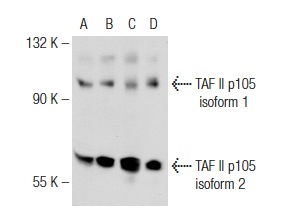
Western blot analysis of TAF II p105 expression in Raji (A), Ramos (B), BJAB (C) and IB4 (D) whole cell lysates.| Product Name | TAF II p105 Antibody (N-16) |
|---|---|
| Antibody Type | Primary Antibodies |
| Antigen Alias | epitope mapping near the N-terminus of TAF II p105 of human origin |
| Modification Notes | TFIID is a general transcription factor that facilitates the preinitiation complex assembly through direct interactions with the TATA promoter element. TFIID is a multisubunit complex consisting of a small TATA-binding polypeptide and other TBP-associated factors (TAFs). TAF II p105, also called TAF4B, is a cell-type specific transcriptional coactivator that is a component of the TFIID complex. Expressed primarily in B cells and ovarian granulosa cells, TAF II p105 can interact with OCBA/POU2AF1 to activate B cell-specific octamer-dependent transcription. Additionally, TAF II p105 plays an important role in coactivating the transcription factor NF-kappaB and is essential for activation of anti-apoptotic genes such as TNFAIP3. Through its C-terminal histone-fold domain, TAF II p105 can form a heterodimer with TAF12/TAF II p20 that can then form a transcriptional activating octamer with several other TAFs. This protein is localized to the nucleus with cytoplasmic export mediated by a CRM1-independent export pathway. There are two isoforms expressed by alternative splicing. |
| Clonality | Polyclonal |
|---|---|
| Isotype | IgG |
| Host Species | Rabbit |
| Tested Applications | WBIPIFELISA |
| recommended for detection of TAF II p105 of mouse, rat and human origin by WB, IP, IF and ELISA also reactive with additional species, including bovine and porcine: |
|
| Species Reactivity | HumanMouseRat |
| Concentration | 1mg/ml |
| Purification | Affinity purified |
| Alternative Names | epitope mapping near the N-terminus of TAF II p105 of human origin |
|---|---|
| Tissue Specificity | epitope mapping near the N-terminus of TAF II p105 of human origin |
| Entrez Gene | 6875 |
|---|
Application
Western blot analysis of TAF II p105 expression in Raji (A), Ramos (B), BJAB (C) and IB4 (D) whole cell lysates.| Application Notes | recommended for detection of TAF II p105 of mouse, rat and human origin by WB, IP, IF and ELISA also reactive with additional species, including bovine and porcine: |
|---|
| Form | Liquid |
|---|---|
| Storage Instructions | For short-term storage, store at 4° C. For long-term storage, aliquot and store at -20ºC or below. Avoid multiple freeze-thaw cycles. |
| Storage Buffer | phosphate buffered saline , pH 7.4, 150mM NaCl, 0.02% sodium azide and 50% glycerol. |


