Application
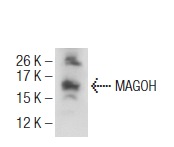
Western blot analysis of MAGOH expression in PC-3 whole cell lysate.| Product Name | MAGOH Antibody (H-117) |
|---|---|
| Antibody Type | Primary Antibodies |
| Antigen Alias | epitope corresponding to amino acids 30-146 mapping near the C-terminus of MAGOH of human origin |
| Modification Notes | MAGOH, the human homolog of Drosophila mago nashi, is required for embryo development. MAGOH is ubiquitously expressed in adult tissues. It has an unusual structure consiting of an extremely flat, six-stranded anti-parallel ∫ sheet packed next to two helices. MAGOH interacts with the Y14 protein to form a complex that plays a crucial role in postsplicing processing (including nuclear export and cytoplasmic localization of the mRNA) and in the nonsense-mediated mRNA decay (NMD) surveillance process. The MAGOH-Y14 complex remains persistently associated in the same position on the mRNA after its export to the cytoplasm and requires translation of the mRNA for removal. This complex may illustrate the mechanism of the pre-mRNA splicing machinery for forming a stable exon-exon junction complex-mRNA at splice junctions. |
| Clonality | Polyclonal |
|---|---|
| Isotype | IgG |
| Host Species | Rabbit |
| Tested Applications | WBIPIFELISA |
| recommended for detection of MAGOH of human, mouse and rat origin and MAGOHB of mouse origin by WB, IP, IF and ELISA also reactive with additional species, including equine, canine, bovine, porcine and avian: |
|
| Species Reactivity | HumanMouseRat |
| Concentration | 1mg/ml |
| Purification | Affinity purified |
| Alternative Names | epitope corresponding to amino acids 30-146 mapping near the C-terminus of MAGOH of human origin |
|---|---|
| Tissue Specificity | epitope corresponding to amino acids 30-146 mapping near the C-terminus of MAGOH of human origin |
| Entrez Gene | 4116 |
|---|
Application
Western blot analysis of MAGOH expression in PC-3 whole cell lysate.| Application Notes | recommended for detection of MAGOH of human, mouse and rat origin and MAGOHB of mouse origin by WB, IP, IF and ELISA also reactive with additional species, including equine, canine, bovine, porcine and avian: |
|---|
| Form | Liquid |
|---|---|
| Storage Instructions | For short-term storage, store at 4° C. For long-term storage, aliquot and store at -20ºC or below. Avoid multiple freeze-thaw cycles. |
| Storage Buffer | phosphate buffered saline , pH 7.4, 150mM NaCl, 0.02% sodium azide and 50% glycerol. |


