Application
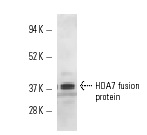
Western blot analysis of C. elegans recombinant HDA7 fusion protein.| Product Name | HDA7 Antibody (Ce-87) |
|---|---|
| Antibody Type | Primary Antibodies |
| Antigen Alias | epitope corresponding to amino acids 33-119 mapping near the N-terminus (Ce) |
| Modification Notes | Remodeling of chromatin structure is believed to be a critical component of transcriptional regulation. A major source of remodeling is brought about by the acetylation of nucleosomal histones. Acetylation results in an allosteric change in the nucleosomal conformation and an increased accessibility of DNA to transcription factors. Conversely, the deacetylation of histones is associated with transcriptional silencing (1). HDA1, HDA2, HDA3, HDA4, HDA5, HDA6 and HDA7 have been identified as histone deacetylases in C. elegans and are homologous with histone deacetylase proteins in both yeast and mammalian systems (2,3). RBA1 and RBA2 are the C. elegans homologues of RbAp46 and RBAp48 respectively. RbAp46 and RbAp48 are Rb and histone binding proteins and are components of the histone deacetylase complex (4-6). |
| Clonality | Polyclonal |
|---|---|
| Isotype | IgG |
| Host Species | Rabbit |
| Tested Applications | WBIPIFELISA |
| recommended for detection of HDA7 of Caenorhabditis elegans origin by WB, IP, IF and ELISA: |
|
| Species Reactivity | HumanMouseRat |
| Concentration | 1mg/ml |
| Purification | Affinity purified |
| Alternative Names | epitope corresponding to amino acids 33-119 mapping near the N-terminus (Ce) |
|---|---|
| Tissue Specificity | epitope corresponding to amino acids 33-119 mapping near the N-terminus (Ce) |
Application
Western blot analysis of C. elegans recombinant HDA7 fusion protein.| Application Notes | recommended for detection of HDA7 of Caenorhabditis elegans origin by WB, IP, IF and ELISA: |
|---|
| Form | Liquid |
|---|---|
| Storage Instructions | For short-term storage, store at 4° C. For long-term storage, aliquot and store at -20ºC or below. Avoid multiple freeze-thaw cycles. |
| Storage Buffer | phosphate buffered saline , pH 7.4, 150mM NaCl, 0.02% sodium azide and 50% glycerol. |


