Application
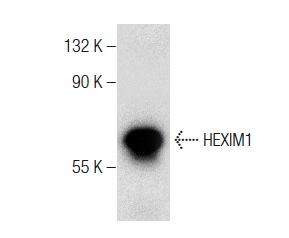
Western blot analysis of HEXIM1 expression in K-562 whole cell lysate.| Product Name | HEXIM1 Antibody (H-66) |
|---|---|
| Antibody Type | Primary Antibodies |
| Antigen Alias | epitope corresponding to amino acids 294-359 mapping at the C-terminus of HEXIM1 of human origin |
| Modification Notes | Hexamethylene bis-acetamide inducible 1 (HEXIM1) and Hexamethylene bis-acetamide inducible 2 (HEXIM2) comprise a family of proteins which inhibit positive transcription elongation factor b (P-TEFb) through association with 7SK. P-TEFb is composed of a catalytic subunit, Cdk9, and either Cyclin T1 or T2 as a regulatory subunit. This complex regulates eukaryotic gene expression at the level of elongation. The C-terminal domains of HEXIM proteins interact directly with each other. Via these domains, HEXIM1 and HEXIM2 form stable homo- and hetero-oligomers, which may aid in the formation of the 7SK small nuclear ribonucleic acid particle. Despite their similar functions, HEXIM1 and HEXIM2 exhibit distinct expression patterns in various established cell lines and human tissues. |
| Clonality | Polyclonal |
|---|---|
| Isotype | IgG |
| Host Species | Rabbit |
| Tested Applications | WBIPIFELISA |
| recommended for detection of HEXIM1 of mouse, rat and human origin by WB, IP, IF and ELISA also reactive with additional species, including equine, canine, bovine and porcine: |
|
| Species Reactivity | HumanMouseRat |
| Concentration | 1mg/ml |
| Purification | Affinity purified |
| Alternative Names | epitope corresponding to amino acids 294-359 mapping at the C-terminus of HEXIM1 of human origin |
|---|---|
| Tissue Specificity | epitope corresponding to amino acids 294-359 mapping at the C-terminus of HEXIM1 of human origin |
| Entrez Gene | 10614 |
|---|
Application
Western blot analysis of HEXIM1 expression in K-562 whole cell lysate.| Application Notes | recommended for detection of HEXIM1 of mouse, rat and human origin by WB, IP, IF and ELISA also reactive with additional species, including equine, canine, bovine and porcine: |
|---|
| Form | Liquid |
|---|---|
| Storage Instructions | For short-term storage, store at 4° C. For long-term storage, aliquot and store at -20ºC or below. Avoid multiple freeze-thaw cycles. |
| Storage Buffer | phosphate buffered saline , pH 7.4, 150mM NaCl, 0.02% sodium azide and 50% glycerol. |


