Application
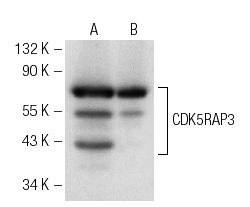
Western blot analysis of CDK5RAP3 expression in A-431 (A) and HeLa (B) whole cell lysates.| Product Name | CDK5RAP3 Antibody (H-300) |
|---|---|
| Antibody Type | Primary Antibodies |
| Antigen Alias | epitope corresponding to amino acids 207-506 mapping at the C-terminus of CDK5RAP3 of human origin |
| Modification Notes | CDK5RAP3 (cyclin dependent kinase 5 regulatory subunit-associated protein 3), also designated C53 or IC53, may be involved in neuronal differentiation, cell proliferation and DNA repair. The role CDK5RAP3 plays in neuronal differentiation may be attributed to its interaction with the Cdk5 activator protein called p35. p35 physically associates with Cdk5 to activate enzymatic activity. Cdk5 activity increases significantly during neuronal differentiation. Upon transfection, CDK5RAP3 is capable of increasing the rate of cell proliferation, suggesting that it may play a role in tumorigenesis. CDK5RAP3 is a regulatory component of the G2/M DNA damage checkpoint in response to genotoxic stress. CDK5RAP3 is expressed in brain, heart, placenta, liver, skeletal muscle, lung, kidney and pancreas and is overexpressed in tumor tissue. Three named isoforms exist for CDK5RAP3 as a result of alternative splicing events. CDK5RAP3 contains two leucine zipper motifs, putative phosphorylation and potential N-myristoylation sites. |
| Clonality | Polyclonal |
|---|---|
| Isotype | IgG |
| Host Species | Rabbit |
| Tested Applications | WBIPIFELISA |
| recommended for detection of CDK5RAP3 of mouse, rat and human origin by WB, IP, IF and ELISA also reactive with additional species, including equine, canine and bovine: |
|
| Species Reactivity | HumanMouseRat |
| Concentration | 1mg/ml |
| Purification | Affinity purified |
| Alternative Names | epitope corresponding to amino acids 207-506 mapping at the C-terminus of CDK5RAP3 of human origin |
|---|---|
| Tissue Specificity | epitope corresponding to amino acids 207-506 mapping at the C-terminus of CDK5RAP3 of human origin |
Application
Western blot analysis of CDK5RAP3 expression in A-431 (A) and HeLa (B) whole cell lysates.| Application Notes | recommended for detection of CDK5RAP3 of mouse, rat and human origin by WB, IP, IF and ELISA also reactive with additional species, including equine, canine and bovine: |
|---|
| Form | Liquid |
|---|---|
| Storage Instructions | For short-term storage, store at 4° C. For long-term storage, aliquot and store at -20ºC or below. Avoid multiple freeze-thaw cycles. |
| Storage Buffer | phosphate buffered saline , pH 7.4, 150mM NaCl, 0.02% sodium azide and 50% glycerol. |


