Application
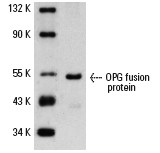
Western blot analysis of human recombinant OPG fusion protein.| Product Name | OPG Antibody (H-249) |
|---|---|
| Antibody Type | Primary Antibodies |
| Antigen Alias | epitope corresponding to amino acids 153-401 of osteoprotegerin of human origin |
| Modification Notes | Bone morphogenesis and remodeling involve the formation of bone from osteoblasts and the resorption of bone by osteoclasts. The cytokine osteoprotegerin (OPG), also designated osteoclastogenesis inhibitory factor (OCIF), is known to inhibit osteoclast formation. A secreted glycoprotein, OPG is a member of the TNF receptor family that increases bone density and volume. OPG is thought to inhibit osteoclastogenesis by disrupting the cell-to-cell signaling between osteoblastic stromal cells and osteoclast progenitors. OPG is known to bind to TRAIL, a death domain-containing protein, and to inhibit TRAIL apoptosis in Jurkat cells. OPG also binds to osteoclast differentiation factor (ODF), also known as TRANCE/RANKL, a membrane-bound protein belonging to the TNF ligand family. Both TNF? and TNF? upregulate OPG expression, while the bone resorbing agent prostaglandin E2 downregulates OPG. |
| Clonality | Polyclonal |
|---|---|
| Isotype | IgG |
| Host Species | Rabbit |
| Tested Applications | WBIPIFELISAChIP |
| recommended for detection of OPG of mouse, rat and human origin by WB, IP, IF and ELISA also reactive with additional species, including equine, canine, bovine and porcine: |
|
| Species Reactivity | HumanMouseRat |
| Concentration | 1mg/ml |
| Purification | Affinity purified |
| Alternative Names | epitope corresponding to amino acids 153-401 of osteoprotegerin of human origin |
|---|---|
| Tissue Specificity | epitope corresponding to amino acids 153-401 of osteoprotegerin of human origin |
| Entrez Gene | 4982 |
|---|
Application
Western blot analysis of human recombinant OPG fusion protein.| Application Notes | recommended for detection of OPG of mouse, rat and human origin by WB, IP, IF and ELISA also reactive with additional species, including equine, canine, bovine and porcine: |
|---|
| Form | Liquid |
|---|---|
| Storage Instructions | For short-term storage, store at 4° C. For long-term storage, aliquot and store at -20ºC or below. Avoid multiple freeze-thaw cycles. |
| Storage Buffer | phosphate buffered saline , pH 7.4, 150mM NaCl, 0.02% sodium azide and 50% glycerol. |


