Application
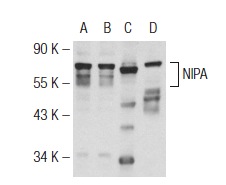
Western blot analysis of NIPA expression in HeLa (A) and WI 38 (B) whole cell lysates and mouse brain (C) and mouse liver (D) tissue extracts.| Product Name | NIPA Antibody (H-300) |
|---|---|
| Antibody Type | Primary Antibodies |
| Antigen Alias | epitope corresponding to amino acids 1-300 mapping at the N-terminus of NIPA of human origin |
| Modification Notes | Entry into mitosis is essentially driven by cyclin B1 which is located in the cytoplasm throughout interphase, but accumulates in the nucleus just before mitosis occurs. Nuclear Interaction Partner of ALK (NIPA) plays a critical role in cyclin B1 regulation. NIPA is normally phosphorylated during G2 and M phases, resulting in an accumulation of cyclin B1. When NIPA sheds its attached phosphate, it binds to SCF to form the SCFNIPA complex, a member of the E3 ubiquitin ligases, which ubiquitinates cyclin B1, thereby targeting it to the proteosome for degradation. Therefore, the accumulation of cyclin B1 is due to the inability of phosphorylated NIPA to bind to the molecule SCF, thereby preventing the degradation of cyclin B1. An absence of NIPA causes cyclin B1 to accumulate abnormally, leading to premature mitotic entry, loss of checkpoint control, and genomic instability which are all associated with cancer. The phosphorylated form of NIPA may also be involved in apoptotic signaling pathways. |
| Clonality | Polyclonal |
|---|---|
| Isotype | IgG |
| Host Species | Rabbit |
| Tested Applications | WBIPIFELISA |
| recommended for detection of NIPA of mouse, rat and human origin by WB, IP, IF and ELISA also reactive with additional species, including equine, canine and bovine: |
|
| Species Reactivity | HumanMouseRat |
| Concentration | 1mg/ml |
| Purification | Affinity purified |
| Alternative Names | epitope corresponding to amino acids 1-300 mapping at the N-terminus of NIPA of human origin |
|---|---|
| Tissue Specificity | epitope corresponding to amino acids 1-300 mapping at the N-terminus of NIPA of human origin |
Application
Western blot analysis of NIPA expression in HeLa (A) and WI 38 (B) whole cell lysates and mouse brain (C) and mouse liver (D) tissue extracts.| Application Notes | recommended for detection of NIPA of mouse, rat and human origin by WB, IP, IF and ELISA also reactive with additional species, including equine, canine and bovine: |
|---|
| Form | Liquid |
|---|---|
| Storage Instructions | For short-term storage, store at 4° C. For long-term storage, aliquot and store at -20ºC or below. Avoid multiple freeze-thaw cycles. |
| Storage Buffer | phosphate buffered saline , pH 7.4, 150mM NaCl, 0.02% sodium azide and 50% glycerol. |


