Application
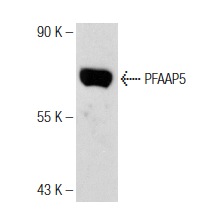
Western blot analysis of PFAAP5 expression in HL-60 whole cell lysate.Application
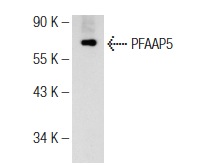
Western blot analysis of PFAAP5 expression in mouse lymph node tissue extract.| Product Name | PFAAP5 Antibody (Y-20) |
|---|---|
| Antibody Type | Primary Antibodies |
| Antigen Alias | epitope mapping within an internal region of PFAAP5 of human origin |
| Modification Notes | PFAAP5 (phosphonoformate immuno-associated protein 5), also known as NEDD4-binding protein 2-like 2, is a 583 amino acid nuclear protein that potentially is involved in transcriptional regulation. PFAAP5 is phosphorylated on Ser 199 in response to DNA damage, probably by ATM or ATR. Primarily expressed in bone marrow, PFAAP5 is dramatically down-regulated after exposure to arsenic compounds, an event which precedes neutropenia. PFAAP5 interacts with both Gfi-1 and Neutrophil Elastase, two proteins that are implicated in neutropenia disorders. Defects in the gene encoding Neutrophil Elastase, ELA2, are the cause of cyclic haematopoiesis, which, with decreased numbers of circulating neutrophils, leads to an increased risk for opportunistic infection. Gfi1 is a transcriptional repressor that targets the ELA2 gene among others. With PFAAP5 expression, Neutrophil Elastase can potentiate repression of Gfi1 target genes, leading to the transcription of ELA2 and subsequent neutrophil differentiation. There are two isoforms of PFAAP5 that are produced as a result of alternative splicing events. |
| Clonality | Polyclonal |
|---|---|
| Isotype | IgG |
| Host Species | Rabbit |
| Tested Applications | WBIPIFELISA |
| recommended for detection of PFAAP5 of mouse, rat and human origin by WB, IP, IF and ELISA also reactive with additional species, including canine, bovine and porcine: |
|
| Species Reactivity | HumanMouseRat |
| Concentration | 1mg/ml |
| Purification | Affinity purified |
| Alternative Names | epitope mapping within an internal region of PFAAP5 of human origin |
|---|---|
| Tissue Specificity | epitope mapping within an internal region of PFAAP5 of human origin |
| Entrez Gene | 10443 |
|---|
Application
Western blot analysis of PFAAP5 expression in HL-60 whole cell lysate.
Application
Western blot analysis of PFAAP5 expression in mouse lymph node tissue extract.| Application Notes | recommended for detection of PFAAP5 of mouse, rat and human origin by WB, IP, IF and ELISA also reactive with additional species, including canine, bovine and porcine: |
|---|
| Form | Liquid |
|---|---|
| Storage Instructions | For short-term storage, store at 4° C. For long-term storage, aliquot and store at -20ºC or below. Avoid multiple freeze-thaw cycles. |
| Storage Buffer | phosphate buffered saline , pH 7.4, 150mM NaCl, 0.02% sodium azide and 50% glycerol. |


