Application
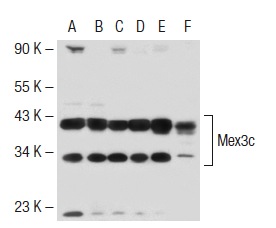
Western blot analysis of Mex3c expression in SK-BR-3 (A), Caki-1 (B), MCF7 (C), HeLa (D), LNCaP (E) and Caco-2 (F) whole cell lysates.Application
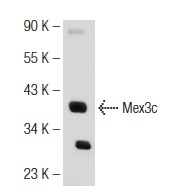
Western blot analysis of Mex3c expression in 293T whole cell lysate.| Product Name | Mex3c Antibody (G-18) |
|---|---|
| Antibody Type | Primary Antibodies |
| Antigen Alias | epitope mapping within an internal region of Mex3c of human origin |
| Modification Notes | Mex-3 (muscle excess protein-3) is a translational regulator in Caenorhabditis elegans that participates in maintaining the germline totipotency and specifies the posterior blastomeres in early embryos. In humans, four evolutionarily conserved Mex-3 homologs exist, namely Mex3a, Mex3b, Mex3c and Mex3d. These proteins comprise a family of RNA binding phosphoproteins, which each contain two tandemly repeated KH (nuclear ribonucleoprotein K homology) domains and one C-terminal RING finger motif. In addition, the Mex-3 homolog family of proteins shuttle between the nucleus and the cytoplasm through the CRM1-dependent export pathway and may play a role regulating post-transcriptional events. Mex3c, also known as RING finger and KH domain-containing protein 2, is a 659 amino acid RNA-binding protein that is expressed at highest levels in fetal brain and testis. Genetic variations in the gene encoding Mex3c may be associated with an increased risk for essential hypertension type 8. |
| Clonality | Polyclonal |
|---|---|
| Isotype | IgG |
| Host Species | Rabbit |
| Tested Applications | WBIPIFELISA |
| recommended for detection of Mex3c of mouse, rat and human origin by WB, IP, IF and ELISA non cross-reactive with Mex67 also reactive with additional species, including equine, canine, bovine and porcine: |
|
| Species Reactivity | HumanMouseRat |
| Concentration | 1mg/ml |
| Purification | Affinity purified |
| Alternative Names | epitope mapping within an internal region of Mex3c of human origin |
|---|---|
| Tissue Specificity | epitope mapping within an internal region of Mex3c of human origin |
| Entrez Gene | 51320 |
|---|
Application
Western blot analysis of Mex3c expression in SK-BR-3 (A), Caki-1 (B), MCF7 (C), HeLa (D), LNCaP (E) and Caco-2 (F) whole cell lysates.
Application
Western blot analysis of Mex3c expression in 293T whole cell lysate.| Application Notes | recommended for detection of Mex3c of mouse, rat and human origin by WB, IP, IF and ELISA non cross-reactive with Mex67 also reactive with additional species, including equine, canine, bovine and porcine: |
|---|
| Form | Liquid |
|---|---|
| Storage Instructions | For short-term storage, store at 4° C. For long-term storage, aliquot and store at -20ºC or below. Avoid multiple freeze-thaw cycles. |
| Storage Buffer | phosphate buffered saline , pH 7.4, 150mM NaCl, 0.02% sodium azide and 50% glycerol. |


