Application
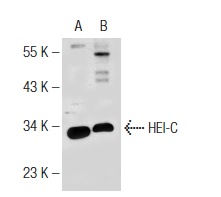
Western blot analysis of HEI-C expression in LADMAC whole cell lysate (A) and mouse lymph node tissue extract (B).| Product Name | HEI-C Antibody (K-18) |
|---|---|
| Antibody Type | Primary Antibodies |
| Antigen Alias | epitope mapping within a cytoplasmic domain of HEI-C of human origin |
| Modification Notes | Mitosis is an important process regulated by many proteins. In the event that cellular division is not controlled, cancer, tumors and cellular death become prevalent. HEI-C (enhancer of invasion-cluster) is also known as CCDC5 (coiled-coil domain containing 5 (spindle associated)) and is a 278 amino acid protein expressed as two isoforms. HEI-C is expressed in a variety of tissues including pancreas, kidney, skeletal muscle, liver and heart, where it is localized to the cytoplasm during phases of the cell cycle, excluding mitosis. HEI-C is localized to asters, and is spotted on the microtubule array during metaphase. During the later stages of mitosis, HEI-C remains only on the spindle, then associates with microtubule bundles central to the midbody of the cell. During the metaphase-anaphase transition of mitosis, HEI-C regulates the function and stability of the mitotic spindle. Depletion of HEI-C results in cell death or mitotic delay between metaphase and anaphase, suggesting the importance of functional HEI-C proteins. |
| Clonality | Polyclonal |
|---|---|
| Isotype | IgG |
| Host Species | Rabbit |
| Tested Applications | WBIPIFELISA |
| recommended for detection of HEI-C of mouse, rat and human origin by WB, IP, IF and ELISA also reactive with additional species, including equine, canine, bovine and porcine: |
|
| Species Reactivity | HumanMouseRat |
| Concentration | 1mg/ml |
| Purification | Affinity purified |
| Alternative Names | epitope mapping within a cytoplasmic domain of HEI-C of human origin |
|---|---|
| Tissue Specificity | epitope mapping within a cytoplasmic domain of HEI-C of human origin |
| Entrez Gene | 115106 |
|---|
Application
Western blot analysis of HEI-C expression in LADMAC whole cell lysate (A) and mouse lymph node tissue extract (B).| Application Notes | recommended for detection of HEI-C of mouse, rat and human origin by WB, IP, IF and ELISA also reactive with additional species, including equine, canine, bovine and porcine: |
|---|
| Form | Liquid |
|---|---|
| Storage Instructions | For short-term storage, store at 4° C. For long-term storage, aliquot and store at -20ºC or below. Avoid multiple freeze-thaw cycles. |
| Storage Buffer | phosphate buffered saline , pH 7.4, 150mM NaCl, 0.02% sodium azide and 50% glycerol. |


