Application
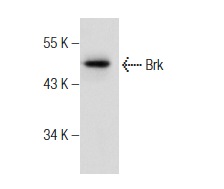
Western blot analysis of Brk expression in mouse colon tissue extract.| Product Name | Brk Antibody (C-17) |
|---|---|
| Antibody Type | Primary Antibodies |
| Antigen Alias | epitope mapping at the C-terminus of Brk of mouse origin |
| Modification Notes | Tyrosine protein kinases play crucial roles in cell proliferation, survival, adhesion and motility by regulating ligand-mediated signal transduction, cell-cycle progression and cytoskeleton function. Tyrosine kinases may also bring about the transformation of malignant cells. Breast tumor kinase, Brk (also known as PTK6), along with its murine homolog, Sik (Src-related intestinal kinase) is one such kinase. Brk is a member of a distinct family of intracellular tyrosine kinases thought to be related to the Src family of tumor-related kinases. Brk exhibits the features of a novel non-receptor tyrosine kinase, including N-terminal SH3 and SH2 domains. Brk is specifically expressed in epithelial tissues and is restricted to cell layers immediately above the proliferative cell zone in skin and alimentary canal lining. Expression of Brk in normal tissues is relatively restricted with the highest mRNA levels found in colon, small intestine and prostate. Brk is strongly expressed in many breast carcinomas but not in normal breast tissue. Brk protein is also capable of autophosphorylation, which may play a role in its regulation. |
| Clonality | Polyclonal |
|---|---|
| Isotype | IgG |
| Host Species | Rabbit |
| Tested Applications | WBIPIFELISA |
| recommended for detection of Brk of mouse and rat origin by WB, IP, IF and ELISA: |
|
| Species Reactivity | HumanMouseRat |
| Concentration | 1mg/ml |
| Purification | Affinity purified |
| Alternative Names | epitope mapping at the C-terminus of Brk of mouse origin |
|---|---|
| Tissue Specificity | epitope mapping at the C-terminus of Brk of mouse origin |
| Entrez Gene | 20459 |
|---|
Application
Western blot analysis of Brk expression in mouse colon tissue extract.| Application Notes | recommended for detection of Brk of mouse and rat origin by WB, IP, IF and ELISA: |
|---|
| Form | Liquid |
|---|---|
| Storage Instructions | For short-term storage, store at 4° C. For long-term storage, aliquot and store at -20ºC or below. Avoid multiple freeze-thaw cycles. |
| Storage Buffer | phosphate buffered saline , pH 7.4, 150mM NaCl, 0.02% sodium azide and 50% glycerol. |


