Application
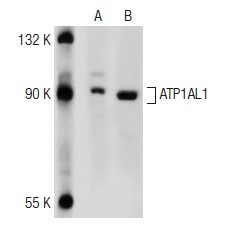
Western blot analysis of ATP1AL1 expression in LADMAC (A) and KNRK (B) whole cell lysates.Application
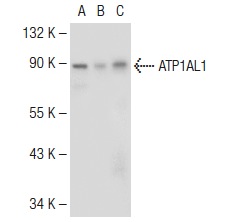
Western blot analysis of ATP1AL1 expression in LADMAC (A) and KNRK (B) whole cell lysates and mouse liver tissue extract (C).| Product Name | ATP1AL1 Antibody (N-12) |
|---|---|
| Antibody Type | Primary Antibodies |
| Antigen Alias | epitope mapping within an internal region of ATP1AL1 of human origin |
| Modification Notes | ATP1AL1, also known as ATP12A, is a 1,039 amino acid multi-pass membrane protein that belongs to the P-type subfamily of cation transport ATPases. Expressed in skin and kidney tissue, ATP1AL1 consists of two subunits, designated alpha and beta, that work to catalyze the hydrolysis of ATP, a reaction that is coupled with the exchange of hydrogen and potassium across the plasma membrane. Via its catalytic and proton pump activity, ATP1AL1 is responsible for the active transport of potassium into the cell, an event that is crucial for cell survival and proper cell function. ATP1AL1 is expressed as two alternatively spliced isoforms that are encoded by a gene which maps to human chromosome 13. |
| Clonality | Polyclonal |
|---|---|
| Isotype | IgG |
| Host Species | Rabbit |
| Tested Applications | WBIPIFELISA |
| recommended for detection of ATP1AL1 of human origin by WB, IP, IF and ELISA also reactive with additional species, including equine, canine and bovine: |
|
| Species Reactivity | HumanMouseRat |
| Concentration | 1mg/ml |
| Purification | Affinity purified |
| Alternative Names | epitope mapping within an internal region of ATP1AL1 of human origin |
|---|---|
| Tissue Specificity | epitope mapping within an internal region of ATP1AL1 of human origin |
| Entrez Gene | 479 |
|---|
Application
Western blot analysis of ATP1AL1 expression in LADMAC (A) and KNRK (B) whole cell lysates.
Application
Western blot analysis of ATP1AL1 expression in LADMAC (A) and KNRK (B) whole cell lysates and mouse liver tissue extract (C).| Application Notes | recommended for detection of ATP1AL1 of human origin by WB, IP, IF and ELISA also reactive with additional species, including equine, canine and bovine: |
|---|
| Form | Liquid |
|---|---|
| Storage Instructions | For short-term storage, store at 4° C. For long-term storage, aliquot and store at -20ºC or below. Avoid multiple freeze-thaw cycles. |
| Storage Buffer | phosphate buffered saline , pH 7.4, 150mM NaCl, 0.02% sodium azide and 50% glycerol. |


