Application
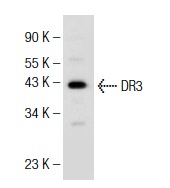
Western blot analysis of DR3 expression in IMR-32 whole cell lysate.Application
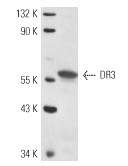
Western blot analysis of DR3 expression in C32 whole cell lysate.| Product Name | DR3 Antibody (H-300) |
|---|---|
| Antibody Type | Primary Antibodies |
| Antigen Alias | epitope corresponding to amino acids 1-300 mapping at the N-terminus of DR3 of human origin |
| Modification Notes | Tumor necrosis factor (TNF)-related cytokines are pleiotropic factors that initiate various cellular processes including cell death, proliferation and differentiation. Their effects are mediated by a family of receptors which includes TNF-R1, TNF-R2, NGFR (nerve growth factor receptor) and FAS. The members of this family are type I membrane receptors and are charaterized by the presence of cysteine-rich repeats in their extracellular domains. Several of these receptors, including TNF-R1 and FAS, contain a region of intracellular homology, designated the death domain, known to signal apoptosis. A new death domain member of this family, DR3 (also designated Wsl-1, APO-3, TRAMP and LARD) has been shown to induce apoptosis and activation of NF˚B. DR3 is most similar in sequence to TNF-R1, but is more restricted in tissue distribution. DR3 is highly expressed in thymocytes and lymphocytes. |
| Clonality | Polyclonal |
|---|---|
| Isotype | IgG |
| Host Species | Rabbit |
| Tested Applications | WBIPIFELISA |
| recommended for detection of DR3 of mouse, rat and human origin by WB, IP, IF and ELISA: |
|
| Species Reactivity | HumanMouseRat |
| Concentration | 1mg/ml |
| Purification | Affinity purified |
| Alternative Names | epitope corresponding to amino acids 1-300 mapping at the N-terminus of DR3 of human origin |
|---|---|
| Tissue Specificity | epitope corresponding to amino acids 1-300 mapping at the N-terminus of DR3 of human origin |
| Entrez Gene | 8718 |
|---|
Application
Western blot analysis of DR3 expression in IMR-32 whole cell lysate.
Application
Western blot analysis of DR3 expression in C32 whole cell lysate.| Application Notes | recommended for detection of DR3 of mouse, rat and human origin by WB, IP, IF and ELISA: |
|---|
| Form | Liquid |
|---|---|
| Storage Instructions | For short-term storage, store at 4° C. For long-term storage, aliquot and store at -20ºC or below. Avoid multiple freeze-thaw cycles. |
| Storage Buffer | phosphate buffered saline , pH 7.4, 150mM NaCl, 0.02% sodium azide and 50% glycerol. |


