Application
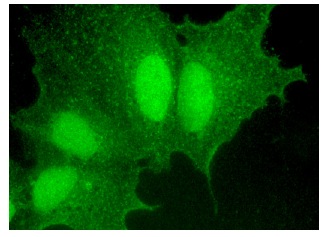
Immunofluorescence staining of formalin-fixed Hep G2 cells showing cytoplasmic and nuclear localization.Application
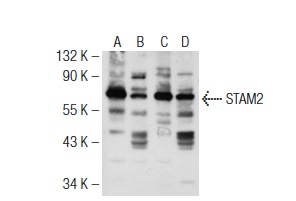
Western blot analysis of STAM2 expression in Caki-1 (A), HeLa (B), SK-N-MC (C) and Hep G2 (D) whole cell lysates.| Product Name | STAM2 Antibody (H-175) |
|---|---|
| Antibody Type | Primary Antibodies |
| Antigen Alias | epitope corresponding to amino acids 351-525 mapping at the C-terminus of STAM2 of human origin |
| Modification Notes | Cytokine stimulation of the IL-2 receptor leads to the tyrosine phosphorylation of a number of cellular proteins and to the induction of various transcription factors including c-Fos and c-Myc. The signal transducing adapter molecule, STAM, is speculated to play a role in c-Myc induction by various cytokines. STAM contains an SH3 (Src homology 3) motif as well as an immunoreceptor tyrosine-based activation (ITAM) motif, both of which appear to be required for c-Myc induction in response to IL-2 and GM-CSF. STAM associates with JAK3 and JAK2 via its ITAM region, and it is tyrosine phosphorylated by JAK3 and JAK2 after stimulation with IL-2 and GM-CSF, respectively. STAM2, also known as Hbp, is a protein that is highly related to STAM. Similar to STAM, STAM2 functions downstream of JAK kinases and can be phosphorylated in response to cytokines. Due to alternative splicing events, two isoforms of STAM2 exist, namely STAM2A and STAM2B. |
| Clonality | Polyclonal |
|---|---|
| Isotype | IgG |
| Host Species | Rabbit |
| Tested Applications | WBIPIFELISA |
| recommended for detection of STAM2 of mouse, rat and human origin by WB, IP, IF and ELISA also reactive with additional species, including equine and canine: |
|
| Species Reactivity | HumanMouseRat |
| Concentration | 1mg/ml |
| Purification | Affinity purified |
| Alternative Names | epitope corresponding to amino acids 351-525 mapping at the C-terminus of STAM2 of human origin |
|---|---|
| Tissue Specificity | epitope corresponding to amino acids 351-525 mapping at the C-terminus of STAM2 of human origin |
| Entrez Gene | 10254 |
|---|
Application
Immunofluorescence staining of formalin-fixed Hep G2 cells showing cytoplasmic and nuclear localization.
Application
Western blot analysis of STAM2 expression in Caki-1 (A), HeLa (B), SK-N-MC (C) and Hep G2 (D) whole cell lysates.| Application Notes | recommended for detection of STAM2 of mouse, rat and human origin by WB, IP, IF and ELISA also reactive with additional species, including equine and canine: |
|---|
| Form | Liquid |
|---|---|
| Storage Instructions | For short-term storage, store at 4° C. For long-term storage, aliquot and store at -20ºC or below. Avoid multiple freeze-thaw cycles. |
| Storage Buffer | phosphate buffered saline , pH 7.4, 150mM NaCl, 0.02% sodium azide and 50% glycerol. |


