Application
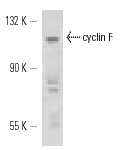
Western blot analysis of cyclin F expression in Ramos nuclear extract.| Product Name | cyclin F Antibody (H-300) |
|---|---|
| Antibody Type | Primary Antibodies |
| Antigen Alias | epitope corresponding to amino acids 15-300 of cyclin F of human origin |
| Modification Notes | Cyclins are the regulatory subunits of Cdc2 p34 and related cyclin dependent kinases (Cdks) which play critical roles in the control of cell cycle progression. The catalytic subunit for cyclin A and B is Cdc2 p34 kinase. The Cdc2-cyclin B complex controls G2 to M transition whereas Cdc2-cyclin A regulates S phase progression. The G1 to S transition, however, appears to be controlled by the G1 cyclins. Cyclin D1 accumulates during G1 and associates with Cdk2, Cdk4 and Cdk5. Cyclin E and Cdk2 interact during the G1 to S transition. Cyclin F is the largest of the cyclins described to date. It contains an extensive PEST-rich C-terminus and a cyclin box region that is most related to cyclins A and B. Cyclin F is ubiquitously expressed in human cells but fluctuates dramatically through the cell cycle, peaking in G2 like cyclin A and decreasing prior to decline of cyclin B. Cyclin F exhibits regulated subcellular localization, being localized in the nucleus in most cells, with a significant percentage of cells showing only perinuclear staining. |
| Clonality | Polyclonal |
|---|---|
| Isotype | IgG |
| Host Species | Rabbit |
| Tested Applications | WBIPIFELISA |
| recommended for detection of cyclin F of mouse, rat and human origin by WB, IP, IF and ELISA also reactive with additional species, including equine, canine, bovine and porcine: |
|
| Species Reactivity | HumanMouseRat |
| Concentration | 1mg/ml |
| Purification | Affinity purified |
| Alternative Names | epitope corresponding to amino acids 15-300 of cyclin F of human origin |
|---|---|
| Tissue Specificity | epitope corresponding to amino acids 15-300 of cyclin F of human origin |
| Entrez Gene | 899 |
|---|
Application
Western blot analysis of cyclin F expression in Ramos nuclear extract.| Application Notes | recommended for detection of cyclin F of mouse, rat and human origin by WB, IP, IF and ELISA also reactive with additional species, including equine, canine, bovine and porcine: |
|---|
| Form | Liquid |
|---|---|
| Storage Instructions | For short-term storage, store at 4° C. For long-term storage, aliquot and store at -20ºC or below. Avoid multiple freeze-thaw cycles. |
| Storage Buffer | phosphate buffered saline , pH 7.4, 150mM NaCl, 0.02% sodium azide and 50% glycerol. |


