Application
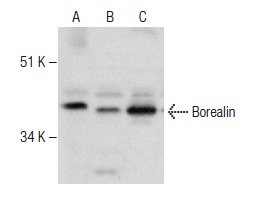
Western blot analysis of Borealin expression in HL-60 (A), MDA-MB-468 (B) and KNRK (C) nuclear extracts.| Product Name | Borealin Antibody (H-41) |
|---|---|
| Antibody Type | Primary Antibodies |
| Antigen Alias | epitope corresponding to amino acids 46-86 mapping near the N-terminus of Borealin of human origin |
| Modification Notes | Borealin is a 280-amino acid protein that stabilizes the bipolar mitotic spindle. Borealin is part of a complex called Aurora B kinase that has essential regulatory roles at centromeres and the central spindle in cells undergoing mitosis. This complex makes up the enzymatic core of the chromosomal passenger complex (CPC). It is possible that the Borealin subunit directs the CPC to centromeric DNA. Deletion of Borealin delays mitotic progression and causes kinetochore-spindle to mis-attach. Deletion also causes an increase in bipolar spindles associated with ectopic asters. These extra poles, which form after chromosomes acquire their bipolar orientation, seriously disrupt chromosome allotment during anaphase. It is true that inappropriate chromosomal segregation and cell division may cause auneuploidy leading to cancer, so an abnormal expression of Borealin may lead to gastric cancer. |
| Clonality | Polyclonal |
|---|---|
| Isotype | IgG |
| Host Species | Rabbit |
| Tested Applications | WBIPIFELISA |
| recommended for detection of Borealin of mouse, rat and human origin by WB, IP, IF and ELISA also reactive with additional species, including equine, canine and bovine: |
|
| Species Reactivity | HumanMouseRat |
| Concentration | 1mg/ml |
| Purification | Affinity purified |
| Alternative Names | epitope corresponding to amino acids 46-86 mapping near the N-terminus of Borealin of human origin |
|---|---|
| Tissue Specificity | epitope corresponding to amino acids 46-86 mapping near the N-terminus of Borealin of human origin |
| Entrez Gene | 55143 |
|---|
Application
Western blot analysis of Borealin expression in HL-60 (A), MDA-MB-468 (B) and KNRK (C) nuclear extracts.| Application Notes | recommended for detection of Borealin of mouse, rat and human origin by WB, IP, IF and ELISA also reactive with additional species, including equine, canine and bovine: |
|---|
| Form | Liquid |
|---|---|
| Storage Instructions | For short-term storage, store at 4° C. For long-term storage, aliquot and store at -20ºC or below. Avoid multiple freeze-thaw cycles. |
| Storage Buffer | phosphate buffered saline , pH 7.4, 150mM NaCl, 0.02% sodium azide and 50% glycerol. |


