Application
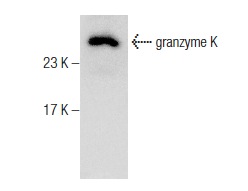
Western blot analysis of granzyme K expression in mouse PBL whole cell lysate.| Product Name | granzyme K Antibody (M-45) |
|---|---|
| Antibody Type | Primary Antibodies |
| Antigen Alias | epitope corresponding to amino acids 121-165 mapping within an internal region of granzyme K of mouse origin |
| Modification Notes | The granzyme family of proteins belong to the larger peptidase S1 family. Granzyme A and granzyme B are serine proteases that facilitate apoptotic signaling in cytotoxic T lymphocytes (CTL) and natural killer (NK) cells. Within the granules of activated CTLs, granzyme A and B are processed and converted to their active forms by the lysosomal cysteine protease cathepsin C. Once cleaved, these active proteases target distinct substrates for proteolysis and, thereby, mediate apoptosis through two different pathways. Granzyme H localizes to cytoplasmic granules of cytolytic T lymphocytes and is important for target cell lysis in cell-mediated immune responses. Granzyme K (GMZK), also designated granzyme-3 or NK-tryptase-2 (NK-TRYP-2), contains one peptidase S1 domain. Granzyme K is a serine protease localizing to the granules of natural killer cells and cytotoxic T lymphocytes. It is primarily expressed in thymus, lung, spleen and peripheral blood leukocytes. |
| Clonality | Polyclonal |
|---|---|
| Isotype | IgG |
| Host Species | Rabbit |
| Tested Applications | WBIPIFELISA |
| recommended for detection of granzyme K of mouse and rat origin by WB, IP, IF and ELISA: |
|
| Species Reactivity | HumanMouseRat |
| Concentration | 1mg/ml |
| Purification | Affinity purified |
| Alternative Names | epitope corresponding to amino acids 121-165 mapping within an internal region of granzyme K of mouse origin |
|---|---|
| Tissue Specificity | epitope corresponding to amino acids 121-165 mapping within an internal region of granzyme K of mouse origin |
| Entrez Gene | 14945 |
|---|
Application
Western blot analysis of granzyme K expression in mouse PBL whole cell lysate.| Application Notes | recommended for detection of granzyme K of mouse and rat origin by WB, IP, IF and ELISA: |
|---|
| Form | Liquid |
|---|---|
| Storage Instructions | For short-term storage, store at 4° C. For long-term storage, aliquot and store at -20ºC or below. Avoid multiple freeze-thaw cycles. |
| Storage Buffer | phosphate buffered saline , pH 7.4, 150mM NaCl, 0.02% sodium azide and 50% glycerol. |


