Application
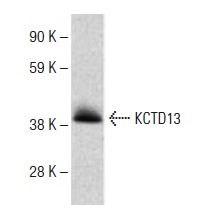
Western blot analysis of KCTD13 expression in human fetal heart tissue extract.| Product Name | KCTD13 Antibody (J-21) |
|---|---|
| Antibody Type | Primary Antibodies |
| Antigen Alias | recommended for detection of KCTD13 of human origin by WB, IP, IF, IHC(P) and ELISA; also reactive with additional species, including canine |
| Modification Notes | The BTB (Broad-Complex, Tramtrack and Bric a brac) domain, also known as the POZ (POxvirus and Zinc finger) domain, is an N-terminal homodimerization domain that contains multiple copies of kelch repeats and/or C2H2-type zinc fingers. Proteins that contain BTB domains are thought to be involved in transcriptional regulation via control of chromatin structure and function. KCTD13 (potassium channel tetramerisation domain containing 13), also known as polymerase delta-interacting protein 1 (PDIP1 or POLDIP1), is a 329 amino acid protein that contains one BTB domain and is expressed in a wide variety of tissues. KCTD13 interacts with proliferating cell nuclear antigen (PCNA) and the small subunit of polymerase delta and plays a role in DNA repair, DNA replication and cell-cycle control. KCTD13 is induced by tumor necrosis factor alpha (TNFå) and by IL-6 suggesting KCTD13 provides a link between cytokine activation and DNA replication. |
| Clonality | Polyclonal |
|---|---|
| Isotype | IgG |
| Host Species | Rabbit |
| Tested Applications | WBIPIFIHCELISA |
| WB:1:500~1:2000 IP:1:100~1:500 IF:1:200~1:500 IHC:1:50~1:200 Notes:Optimal dilutions/concentrations should be determined by the researcher. |
|
| Species Reactivity | HumanMouseRat |
| Concentration | 1mg/ml |
| Purification | Affinity purified |
| Alternative Names | recommended for detection of KCTD13 of human origin by WB IP IF IHC(P) and ELISA also reactive with additional species including canine |
|---|---|
| Tissue Specificity | recommended for detection of KCTD13 of human origin by WB, IP, IF, IHC(P) and ELISA; also reactive with additional species, including canine |
| Entrez Gene | 253980 |
|---|
Application
Western blot analysis of KCTD13 expression in human fetal heart tissue extract.| Application Notes | WB:1:500~1:2000 IP:1:100~1:500 IF:1:200~1:500 IHC:1:50~1:200 Notes:Optimal dilutions/concentrations should be determined by the researcher. |
|---|
| Form | Liquid |
|---|---|
| Storage Instructions | For short-term storage, store at 4° C. For long-term storage, aliquot and store at -20ºC or below. Avoid multiple freeze-thaw cycles. |
| Storage Buffer | phosphate buffered saline , pH 7.4, 150mM NaCl, 0.02% sodium azide and 50% glycerol. |


