Application
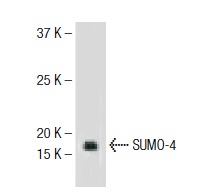
Western blot analysis of SUMO-4 expression in Hep G2 whole cell lysate.| Product Name | SUMO-4 Antibody (Z-22) |
|---|---|
| Antibody Type | Primary Antibodies |
| Antigen Alias | recommended for detection of SUMO-4 of human origin by WB, IF, IHC(P) and ELISA |
| Modification Notes | The small ubiquitin-related modifier (SUMO) proteins, which include SUMO-1, SUMO-2, SUMO-3 and SUMO-4, belong to the ubiquitin-like protein family. Like ubiquitin, the SUMO proteins are synthesized as precursor proteins that undergo processing before conjugation to target proteins. Ubiquitin and SUMO proteins utilize the E1, E2 and E3 cascade enzymes for conjugation. However, SUMO and ubiquitin differ with respect to targeting. Ubiquitination predominantly targets proteins for degradation, whereas sumoylation targets proteins for a variety of cellular processing, including nuclear transport, transcriptional regulation, apoptosis and protein stability. The unconjugated SUMO-1, SUMO-2, SUMO-3 and SUMO-4 proteins localize to the nucleus. In contrast to the other SUMO proteins, SUMO-4 seems to be insensitive to sentrin-specific proteases due to the presence of Pro-90, which may impair processing to mature form and conjugation to substrates. It is suggested that defects in the gene that encodes for the SUMO-4 protein may be involved in the pathogenesis of type I diabetes. |
| Clonality | Polyclonal |
|---|---|
| Isotype | IgG |
| Host Species | Rabbit |
| Tested Applications | WBIFIHCELISA |
| WB:1:500~1:2000 IF:1:200~1:500 IHC:1:50~1:200 Notes:Optimal dilutions/concentrations should be determined by the researcher. |
|
| Species Reactivity | HumanMouseRat |
| Concentration | 1mg/ml |
| Purification | Affinity purified |
| Alternative Names | recommended for detection of SUMO-4 of human origin by WB IF IHC(P) and ELISA |
|---|---|
| Tissue Specificity | recommended for detection of SUMO-4 of human origin by WB, IF, IHC(P) and ELISA |
| Entrez Gene | 387082 |
|---|
Application
Western blot analysis of SUMO-4 expression in Hep G2 whole cell lysate.| Application Notes | WB:1:500~1:2000 IF:1:200~1:500 IHC:1:50~1:200 Notes:Optimal dilutions/concentrations should be determined by the researcher. |
|---|
| Form | Liquid |
|---|---|
| Storage Instructions | For short-term storage, store at 4° C. For long-term storage, aliquot and store at -20ºC or below. Avoid multiple freeze-thaw cycles. |
| Storage Buffer | phosphate buffered saline , pH 7.4, 150mM NaCl, 0.02% sodium azide and 50% glycerol. |


