Application
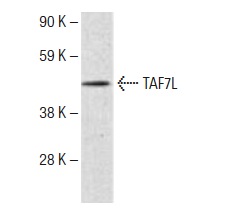
Western blot analysis of TAF7L expression in SP2/0 whole cell lysate.| Product Name | TAF7L Antibody (S-24) |
|---|---|
| Antibody Type | Primary Antibodies |
| Antigen Alias | recommended for detection of TAF7L of mouse origin by WB, IP and ELISA |
| Modification Notes | In eukaryotic systems, initiation of transcription from protein-coding genes is a complex process requiring RNA polymerase II and broad families of auxiliary transcription factors. One class of these factors is TFIID (transcription Factor II D), a multimeric protein complex that mediates promoter responses to various activators and repressors. TAF7L (Transcription initiation factor TFIID subunit 7-like), also known as Transcription initiation factor TFIID 50 kDa subunit and RNA polymerase II TBP-associated factor subunit Q, is a 462 amino acid testis-specific protein that is a component of TFIID. TAF7L replaces TAF7 in the spermatogenesis-specific form of TFIID, where is interacts with TAF1 and TATA-binding protein. In spermatogonia and early spermatocytes TAF7L is located within the cytoplasm, though it is localized to the nucleus in spermatocytes and round spermatids. There are three isoforms of TAF7L that are produced as a result of alternative splicing events. |
| Clonality | Polyclonal |
|---|---|
| Isotype | IgG |
| Host Species | Rabbit |
| Tested Applications | WBIPELISA |
| WB:1:500~1:2000 IP:1:100~1:500 Notes:Optimal dilutions/concentrations should be determined by the researcher. |
|
| Species Reactivity | HumanMouseRat |
| Concentration | 1mg/ml |
| Purification | Affinity purified |
| Alternative Names | recommended for detection of TAF7L of mouse origin by WB IP and ELISA |
|---|---|
| Tissue Specificity | recommended for detection of TAF7L of mouse origin by WB, IP and ELISA |
| Entrez Gene | 74469 |
|---|
Application
Western blot analysis of TAF7L expression in SP2/0 whole cell lysate.| Application Notes | WB:1:500~1:2000 IP:1:100~1:500 Notes:Optimal dilutions/concentrations should be determined by the researcher. |
|---|
| Form | Liquid |
|---|---|
| Storage Instructions | For short-term storage, store at 4° C. For long-term storage, aliquot and store at -20ºC or below. Avoid multiple freeze-thaw cycles. |
| Storage Buffer | phosphate buffered saline , pH 7.4, 150mM NaCl, 0.02% sodium azide and 50% glycerol. |


