Application
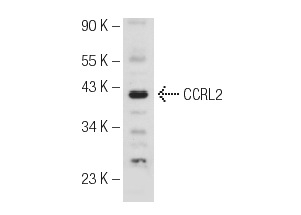
Western blot analysis of CCRL2 expression in K-562 whole cell lysate.| Product Name | CCRL2 Antibody (S-12) |
|---|---|
| Antibody Type | Primary Antibodies |
| Antigen Alias | epitope mapping within an extracellular domain of CCRL2 of human origin |
| Modification Notes | CCRL2 (C-C chemokine receptor-like 2), also known as chemokine receptor X, human chemokine receptor (HCR), CRAM-A or CRAM-B, is a seven pass transmembrane protein expressed by monocytes, neutrophils, and dendritic cells of immunal tissues (predominanly spleen, fetal liver, bone marrow and lymph node). It shares over 40% homology with other C-C chemokine receptors but does not share the conserved DRY motif which is among the important motifs necessary for signalling and ligand-binding. C-C chemokine receptors are G-protein coupled, seven pass transmembrane domain proteins whose major physiological role is to function in the chemotaxis of T cells and phagocytic cells to areas of inflammation. CCRL2 responds to inflammatory chemokines and is upregulated in cells stimulated with lipopolysaccharide (LPS). It may function as a receptor for CCL2, CCL5, CCL7 and CCL8. In addition, CCRL2 may be involved in the pathogenesis of rheumatoid arthritis (RA). |
| Clonality | Polyclonal |
|---|---|
| Isotype | IgG |
| Host Species | Rabbit |
| Tested Applications | WBIPIFELISA |
| recommended for detection of CCRL2 of human origin by WB, IP, IF and ELISA: |
|
| Species Reactivity | HumanMouseRat |
| Concentration | 1mg/ml |
| Purification | Affinity purified |
| Alternative Names | epitope mapping within an extracellular domain of CCRL2 of human origin |
|---|---|
| Tissue Specificity | epitope mapping within an extracellular domain of CCRL2 of human origin |
| Entrez Gene | 9034 |
|---|
Application
Western blot analysis of CCRL2 expression in K-562 whole cell lysate.| Application Notes | recommended for detection of CCRL2 of human origin by WB, IP, IF and ELISA: |
|---|
| Form | Liquid |
|---|---|
| Storage Instructions | For short-term storage, store at 4° C. For long-term storage, aliquot and store at -20ºC or below. Avoid multiple freeze-thaw cycles. |
| Storage Buffer | phosphate buffered saline , pH 7.4, 150mM NaCl, 0.02% sodium azide and 50% glycerol. |


