Application
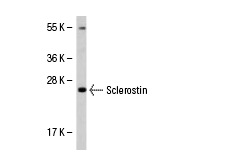
Western blot analysis of Sclerostin expression in mouse liver tissue extract.Application
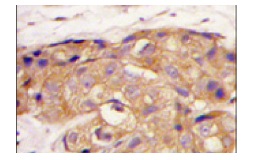
Immunoperoxidase staining of formalin fixed, paraffin-embedded human breast carcinoma tissue showing cytoplasmic staining.| Product Name | Sclerostin Antibody (N-22) |
|---|---|
| Antibody Type | Primary Antibodies |
| Antigen Alias | recommended for detection of Sclerostin of mouse and human origin by WB, IP, IF, IHC(P) and ELISA |
| Modification Notes | Sclerosteosis (SOST), an autosomal recessive sclerosing bone dysplasia, and Van Buchem disease, a closely related disorder, cause abnormal, progressive bone overgrowth. SOST is associated with mutations in the SOST gene and leads to gigantism, entrapment of the seventh and eighth cranial nerves and possibly also distortion of the facies. Van Buchem disease is associated with a 52 kb deletion downstream of the SOST gene that probably affects transcription of the gene. Sclerostin, the protein encoded by the SOST gene, is important for bone homeostasis. It is a secreted protein that inhibits bone formation. Sclerostin is generally expressed at low levels, but high expression of Sclerostin can be detected in bone, cartilage, liver, bone marrow and kidney tissue. |
| Clonality | Polyclonal |
|---|---|
| Isotype | IgG |
| Host Species | Rabbit |
| Tested Applications | WBIPIFIHCELISA |
| See 2 citations for SclerostinAntibody (N-22): |
|
| Species Reactivity | HumanMouseRat |
| Concentration | 1mg/ml |
| Purification | Affinity purified |
| Alternative Names | recommended for detection of Sclerostin of mouse and human origin by WB IP IF IHC(P) and ELISA |
|---|---|
| Tissue Specificity | recommended for detection of Sclerostin of mouse and human origin by WB, IP, IF, IHC(P) and ELISA |
| Entrez Gene | 50964 |
|---|
Application
Western blot analysis of Sclerostin expression in mouse liver tissue extract.
Application
Immunoperoxidase staining of formalin fixed, paraffin-embedded human breast carcinoma tissue showing cytoplasmic staining.| Application Notes | See 2 citations for SclerostinAntibody (N-22): |
|---|
| Form | Liquid |
|---|---|
| Storage Instructions | For short-term storage, store at 4° C. For long-term storage, aliquot and store at -20ºC or below. Avoid multiple freeze-thaw cycles. |
| Storage Buffer | phosphate buffered saline , pH 7.4, 150mM NaCl, 0.02% sodium azide and 50% glycerol. |


