Application
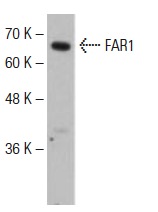
Western blot analysis of FAR1 expression in Hep G2 whole cell lysate.| Product Name | FAR1 Antibody (B-23) |
|---|---|
| Antibody Type | Primary Antibodies |
| Antigen Alias | recommended for detection of FAR1 of mouse, rat and human origin by WB, IP and ELISA |
| Modification Notes | MAP kinase cascades, consisting of a mitogen-activated protein kinase (also called ERK, for extracellular regulated kinase) and one or more upstream regulatory kinases (MAPKKs), play an integral role in signal transduction. The best characterized MAP kinase pathway to date is the yeast pheromone response pathway (1). Extracellular pheromones bind to the receptors Ste2 and Ste3 on the cell surface. Activation of these receptors eventually leads to stimulation of the MAPKKK Ste11 (2). Upon phosphorylation, Ste11 activates the MAPKK Ste7 (3), which in turn activates the MAP kinases Fus3 (also called Dac2) and Kss1 (4,5). These MAP kinases activate the transcription factor Ste12, which upregulates mating-specific genes (6,7), and Far1, which arrests the cell cycle (8). |
| Clonality | Polyclonal |
|---|---|
| Isotype | IgG |
| Host Species | Rabbit |
| Tested Applications | WBIPELISA |
| WB:1:500~1:2000 IP:1:100~1:500 Notes:Optimal dilutions/concentrations should be determined by the researcher. |
|
| Species Reactivity | HumanMouseRat |
| Concentration | 1mg/ml |
| Purification | Affinity purified |
| Alternative Names | recommended for detection of FAR1 of mouse rat and human origin by WB IP and ELISA |
|---|---|
| Tissue Specificity | recommended for detection of FAR1 of mouse, rat and human origin by WB, IP and ELISA |
| Entrez Gene | 84188 |
|---|
Application
Western blot analysis of FAR1 expression in Hep G2 whole cell lysate.| Application Notes | WB:1:500~1:2000 IP:1:100~1:500 Notes:Optimal dilutions/concentrations should be determined by the researcher. |
|---|
| Form | Liquid |
|---|---|
| Storage Instructions | For short-term storage, store at 4° C. For long-term storage, aliquot and store at -20ºC or below. Avoid multiple freeze-thaw cycles. |
| Storage Buffer | phosphate buffered saline , pH 7.4, 150mM NaCl, 0.02% sodium azide and 50% glycerol. |


