Application
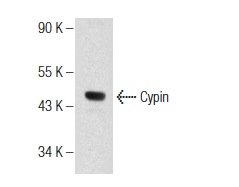
Western blot analysis of Cypin expression in NRK whole cell lysate.| Product Name | Cypin Antibody (H-300) |
|---|---|
| Antibody Type | Primary Antibodies |
| Antigen Alias | epitope corresponding to amino acids 50-349 mapping near the N-terminus of Cypin of human origin |
| Modification Notes | The assembly of neurotransmitter receptors and associated signal transduction machinery at synaptic sites involves postsynaptic density 95 (PSD-95) and related membrane-associated guanylate kinase (MAGUK) proteins (1-4). Cypin, (Cytoplasmic PSD-95 interactor, also designated guanine deaminase and nedasin S), regulates intermediate steps in postsynaptic protein sorting, such as synaptic clustering of MAGUK proteins, and associates with multiple members of the PSD-95 family (1-6). Expressed both pre- and post-synaptically, cypin is most prevalent within the cytoplasm of dendritic shafts and in the neck of synaptic spines (1,2). In non-neuronal cells, cypin is most highly expressed in the basal membrane of intestinal epithelial cells (1). Cypin is also highly expressed in kidney, liver, lung, brain, and spleen, with lower levels of expression in placenta, heart, and skeletal muscle (1). Native cypin may also be expressed as a dimer and a tetramer (6). |
| Clonality | Polyclonal |
|---|---|
| Isotype | IgG |
| Host Species | Rabbit |
| Tested Applications | WBIPIFELISA |
| recommended for detection of Cypin of mouse, rat and human origin by WB, IP, IF and ELISA also reactive with additional species, including canine and bovine: |
|
| Species Reactivity | HumanMouseRat |
| Concentration | 1mg/ml |
| Purification | Affinity purified |
| Alternative Names | epitope corresponding to amino acids 50-349 mapping near the N-terminus of Cypin of human origin |
|---|---|
| Tissue Specificity | epitope corresponding to amino acids 50-349 mapping near the N-terminus of Cypin of human origin |
| Entrez Gene | 9615 |
|---|
Application
Western blot analysis of Cypin expression in NRK whole cell lysate.| Application Notes | recommended for detection of Cypin of mouse, rat and human origin by WB, IP, IF and ELISA also reactive with additional species, including canine and bovine: |
|---|
| Form | Liquid |
|---|---|
| Storage Instructions | For short-term storage, store at 4° C. For long-term storage, aliquot and store at -20ºC or below. Avoid multiple freeze-thaw cycles. |
| Storage Buffer | phosphate buffered saline , pH 7.4, 150mM NaCl, 0.02% sodium azide and 50% glycerol. |


