Application
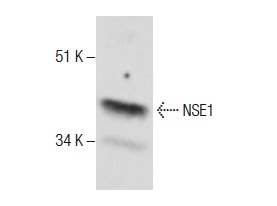
Western blot analysis of NSE1 expression in HL-60 whole cell lysate.| Product Name | NSE1 Antibody (H-178) |
|---|---|
| Antibody Type | Primary Antibodies |
| Antigen Alias | epitope corresponding to amino acids 1-178 mapping at the N-terminus of NSE1 of human origin |
| Modification Notes | Breaks in double stranded DNA often arise during DNA replication or as a result of exposure to DNA-damaging agents. Quick and accurate repair of these breaks is crucial for cell survival and genomic stability. Structural maintenance of chromosomes (SMC) family members form heterodimeric complexes that modulate sister chromatid cohesion and chromosome condensation during mitosis. SMC5 and SMC6 play a crucial role in DNA repair as they form a complex with six conserved nonSMC subunits, including a ubiquitin E3 ligase NSE1 and a SUMO ligase NSE2. Specifically, this complex is crucial for sister chromatid homologous recombination DNA repair and also for prevention of chromosomal rearrangements. The NSE1 protein contains a RING-like motif that promotes DNA repair functions of the SMC5/SMC6 complex and full deletion of NSE1 is lethal to cells. NSE2 stimulates sumoylation of SMC6 and the DNA repair protein TRAX. Depletion of the NSE2 protein by RNA interference leaves the cell vulnerable to DNA damage-induced apoptosis. |
| Clonality | Polyclonal |
|---|---|
| Isotype | IgG |
| Host Species | Rabbit |
| Tested Applications | WBIPIFELISA |
| recommended for detection of NSE1 of mouse, rat and human origin by WB, IP, IF and ELISA also reactive with additional species, including equine, canine and bovine: |
|
| Species Reactivity | HumanMouseRat |
| Concentration | 1mg/ml |
| Purification | Affinity purified |
| Alternative Names | epitope corresponding to amino acids 1-178 mapping at the N-terminus of NSE1 of human origin |
|---|---|
| Tissue Specificity | epitope corresponding to amino acids 1-178 mapping at the N-terminus of NSE1 of human origin |
| Entrez Gene | 197370 |
|---|
Application
Western blot analysis of NSE1 expression in HL-60 whole cell lysate.| Application Notes | recommended for detection of NSE1 of mouse, rat and human origin by WB, IP, IF and ELISA also reactive with additional species, including equine, canine and bovine: |
|---|
| Form | Liquid |
|---|---|
| Storage Instructions | For short-term storage, store at 4° C. For long-term storage, aliquot and store at -20ºC or below. Avoid multiple freeze-thaw cycles. |
| Storage Buffer | phosphate buffered saline , pH 7.4, 150mM NaCl, 0.02% sodium azide and 50% glycerol. |


