Application
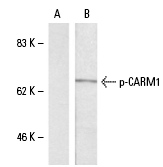
Antibodies tested include p-CARM1 (Ser 228): preincubated with cognate phosphorylated peptide (A) and p-CARM1 (Ser 228): (B).| Product Name | p-CARM1 Antibody (Ser 228) |
|---|---|
| Antibody Type | Primary Antibodies |
| Antigen Alias | epitope corresponding to phosphorylated Ser 228 of CARM1 of human origin |
| Modification | Phosphoralated |
| Modification Notes | CARM1 (coactivator-associated arginine methyltransferase 1), also known as protein arginine N-methyltransferase 4 (PRMT4), is a 585 amino acid nuclear and cytoplasmic protein belonging to the protein arginine N-methyltransferase family. As a protein arginine N-methyltransferase, CARM1 is capable of catalyzing the transfer of methyl groups from S-adenosylmethionine to the guanidino group nitrogen atoms of arginine residues in certain proteins involved in mRNA stability, DNA packaging and transcriptional regulation. The methyltransferase activity of CARM1 has been found to be negatively regulated through phosphorylation at a conserved serine residue. CARM1 acts as a positive regulator for multiple transcription factors and functions as a secondary coactivator through its association with p160 coactivators. CARM1 exists as two alternatively spliced isoforms, and is encoded by a gene that maps to human chromosome 19p13.2. |
| Clonality | Polyclonal |
|---|---|
| Isotype | IgG |
| Host Species | Rabbit |
| Tested Applications | WBIP |
| recommended for detection of Ser 228 phosphorylated CARM1 of human origin and correspondingly phosphorylated Ser 229 of mouse and rat origin by WB and IP: |
|
| Species Reactivity | HumanMouseRat |
| Concentration | 1mg/ml |
| Purification | Affinity purified |
| Alternative Names | epitope corresponding to phosphorylated Ser 228 of CARM1 of human origin |
|---|---|
| Tissue Specificity | epitope corresponding to phosphorylated Ser 228 of CARM1 of human origin |
| Entrez Gene | 10498 |
|---|
Application
Antibodies tested include p-CARM1 (Ser 228): preincubated with cognate phosphorylated peptide (A) and p-CARM1 (Ser 228): (B).| Application Notes | recommended for detection of Ser 228 phosphorylated CARM1 of human origin and correspondingly phosphorylated Ser 229 of mouse and rat origin by WB and IP: |
|---|
| Form | Liquid |
|---|---|
| Storage Instructions | For short-term storage, store at 4° C. For long-term storage, aliquot and store at -20ºC or below. Avoid multiple freeze-thaw cycles. |
| Storage Buffer | phosphate buffered saline , pH 7.4, 150mM NaCl, 0.02% sodium azide and 50% glycerol. |


