Application
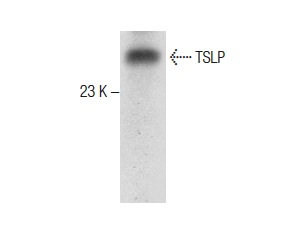
Western blot analysis of TSLP expression in human prostate tissue extract.| Product Name | TSLP Antibody (FL-159) |
|---|---|
| Antibody Type | Primary Antibodies |
| Antigen Alias | epitope corresponding to amino acids 12-159 mapping at the C-terminus of TSLP of human origin |
| Modification Notes | Thymic stromal lymphopoietin (TSLP) is a novel member of the hemopoietic cytokine family that promotes the development of B cells and shares overlapping activity with IL-7 (1,2). The gene encoding murine TSLP maps to chromosome 18 and its human homologue is expressed in several tissues, including heart, liver and prostate (1,3). TSLP mediates its function by binding to a receptor complex (2,4,5). TSLP first binds with low affinity to a TSLP-specific chain designated TSLPR, and then forms a high affinity complex with the IL-7Ra subunit, which explains the overlapping biological properties between TSLP and IL-7 (4,6). Both TSLP and IL-7 induce phosphorylation of the transcription factor Stat5, but unlike IL-7, TSLP-mediated signaling does not activate the JAKs (1,4,7). TSLP prevents apoptosis and stimulates the proliferation of myeloid cells, which is supported by the coexpression of TSLPR and IL-7Ra on monocytes and dendritic cells (1,4). |
| Clonality | Polyclonal |
|---|---|
| Isotype | IgG |
| Host Species | Rabbit |
| Tested Applications | WBIPIFELISA |
| recommended for detection of TSLP of human origin by WB, IP, IF and ELISA: |
|
| Species Reactivity | HumanMouseRat |
| Concentration | 1mg/ml |
| Purification | Affinity purified |
| Alternative Names | epitope corresponding to amino acids 12-159 mapping at the C-terminus of TSLP of human origin |
|---|---|
| Tissue Specificity | epitope corresponding to amino acids 12-159 mapping at the C-terminus of TSLP of human origin |
| Entrez Gene | 85480 |
|---|
Application
Western blot analysis of TSLP expression in human prostate tissue extract.| Application Notes | recommended for detection of TSLP of human origin by WB, IP, IF and ELISA: |
|---|
| Form | Liquid |
|---|---|
| Storage Instructions | For short-term storage, store at 4° C. For long-term storage, aliquot and store at -20ºC or below. Avoid multiple freeze-thaw cycles. |
| Storage Buffer | phosphate buffered saline , pH 7.4, 150mM NaCl, 0.02% sodium azide and 50% glycerol. |


