Application
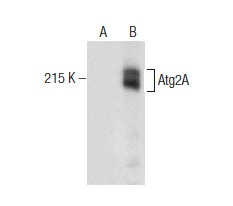
Western blot analysis of Atg2A expression in non-transfected: (A) and human Atg2A transfected: (B) 293T whole cell lysates.| Product Name | Atg2A Antibody (N-14) |
|---|---|
| Antibody Type | Primary Antibodies |
| Antigen Alias | epitope mapping at the N-terminus of Atg2A of human origin |
| Modification Notes | Atg2A (TG2 autophagy related 2 homolog A) is a 1,938 amino acid protein that belongs to the ATG2 family and may play a role in vesicle assembly. Encoded by a gene that maps to human chromosome 11q13.1, Atg2A is conserved in chimpanzee, dog, cow, mouse and rat, and exists as four alternatively spliced isoforms. Undetected in adult tissues, including heart, brain, placenta, lung, liver and skeletal muscle, Atg2A regulation may act as a distinct indicator of autophagic programmed cell death. Atg2A is upregulated in both etoposide- and doxorubicin-induced apoptosis of HeLa cells, suggesting that Atg2A functions as a novel biomarker of topoisomerase II inhibitor-mediated apoptosis. Atg2A associates with Atg2B, indicating that these two related proteins also functionally interact. Atg2A frameshift mutations are linked to gastric and colorectal carcinomas with high microsatellite instability and may contribute to cancer development by deregulating the autophagy process. |
| Clonality | Polyclonal |
|---|---|
| Isotype | IgG |
| Host Species | Rabbit |
| Tested Applications | WBIPIFELISA |
| recommended for detection of Atg2A of mouse, rat and human origin by WB, IP, IF and ELISA non cross-reactive with Atg2B also reactive with additional species, including equine, canine, bovine and porcine: |
|
| Species Reactivity | HumanMouseRat |
| Concentration | 1mg/ml |
| Purification | Affinity purified |
| Alternative Names | epitope mapping at the N-terminus of Atg2A of human origin |
|---|---|
| Tissue Specificity | epitope mapping at the N-terminus of Atg2A of human origin |
| Entrez Gene | 23130 |
|---|
Application
Western blot analysis of Atg2A expression in non-transfected: (A) and human Atg2A transfected: (B) 293T whole cell lysates.| Application Notes | recommended for detection of Atg2A of mouse, rat and human origin by WB, IP, IF and ELISA non cross-reactive with Atg2B also reactive with additional species, including equine, canine, bovine and porcine: |
|---|
| Form | Liquid |
|---|---|
| Storage Instructions | For short-term storage, store at 4° C. For long-term storage, aliquot and store at -20ºC or below. Avoid multiple freeze-thaw cycles. |
| Storage Buffer | phosphate buffered saline , pH 7.4, 150mM NaCl, 0.02% sodium azide and 50% glycerol. |


