Application
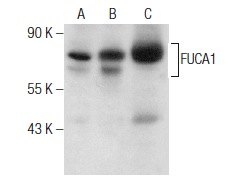
Western blot analysis of FUCA1 expression in K-562 (A) and HL-60 (B) whole cell lysates and human stomach tissue extract (C).| Product Name | FUCA1 Antibody (H-87) |
|---|---|
| Antibody Type | Primary Antibodies |
| Antigen Alias | epitope corresponding to amino acids 151-237 mapping within an internal region of FUCA1 of human origin |
| Modification Notes | FUCA1 (fucosidase, alpha-L- 1, tissue) is a 466 amino acid membrane- and seminal-associated isozyme that is a member of the glycosyl hydrolase 29 family. FUCA1 functions as a homotetramer and is responsible for hydrolyzing and reducing the carbohydrate moieties of glycoproteins in various tissues. Defects in the gene encoding FUCA1 result in fucosidosis, an autosomal recessive disorder caused by an accumulation of fucose-containing glycolipids and glycoproteins. Fucosidosis, a lysosomal storage disease, is characterized by neurologic deterioration, growth retardation, visceromegaly, and seizures. Early onset of fucosidosis causes coarse facial features, angiokeratoma corporis diffusum, spasticity, delayed psychomotor development and an unusual spondylometaphyseoepiphyseal dysplasia. |
| Clonality | Polyclonal |
|---|---|
| Isotype | IgG |
| Host Species | Rabbit |
| Tested Applications | WBIPIFELISA |
| recommended for detection of FUCA1 of mouse, rat and human origin by WB, IP, IF and ELISA non cross-reactive with FUCA2 also reactive with additional species, including equine, canine, bovine and porcine: |
|
| Species Reactivity | HumanMouseRat |
| Concentration | 1mg/ml |
| Purification | Affinity purified |
| Alternative Names | epitope corresponding to amino acids 151-237 mapping within an internal region of FUCA1 of human origin |
|---|---|
| Tissue Specificity | epitope corresponding to amino acids 151-237 mapping within an internal region of FUCA1 of human origin |
Application
Western blot analysis of FUCA1 expression in K-562 (A) and HL-60 (B) whole cell lysates and human stomach tissue extract (C).| Application Notes | recommended for detection of FUCA1 of mouse, rat and human origin by WB, IP, IF and ELISA non cross-reactive with FUCA2 also reactive with additional species, including equine, canine, bovine and porcine: |
|---|
| Form | Liquid |
|---|---|
| Storage Instructions | For short-term storage, store at 4° C. For long-term storage, aliquot and store at -20ºC or below. Avoid multiple freeze-thaw cycles. |
| Storage Buffer | phosphate buffered saline , pH 7.4, 150mM NaCl, 0.02% sodium azide and 50% glycerol. |


