Application
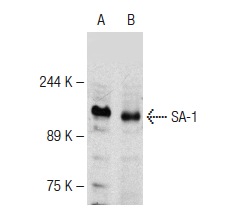
Western blot analysis of SA-1 expression in HEL 92.1.7 (A) and HuT 78 (B) whole cell lysates.| Product Name | SA-1 Antibody (H-86) |
|---|---|
| Antibody Type | Primary Antibodies |
| Modification Notes | The cohesion complex is a multi-protein structure that is required for cohesion of sister chromatids after DNA replication and may be involved in mitotic spindle pole assembly. The complex is composed of a heterodimer between SMC1 and SMC3, two proteins that are linked at their heads by Rad21, and an additional protein called SA-1 (stromal antigen 1). SA-1, also known as STAG1, is a 1258 amino acid component of the cohesion complex that interacts directly with Rad21. Localized to the nucleus, SA-1 associates with chromatin and, upon phosphorylation by Plk, dissociates from chromatin to allow proper chromosome separation during anaphase. SA-1, the human homolog of yeast Scc3p, is expressed in thymus, bone marrow and spleen and is 99% similar to its mouse counterpart. |
| Clonality | Polyclonal |
|---|---|
| Isotype | IgG |
| Host Species | Rabbit |
| Tested Applications | WBIPIFELISA |
| recommended for detection of SA-1 of mouse, rat and human origin by WB, IP, IF and ELISA also reactive with additional species, including canine, bovine, porcine and avian | |
| Species Reactivity | HumanMouseRat |
| Concentration | 1mg/ml |
| Purification | Affinity purified |
| Alternative Names | epitope corresponding to amino acids 1117-1202 mapping near the C-terminus of SA-1 of human origin |
|---|---|
| Tissue Specificity | epitope corresponding to amino acids 1117-1202 mapping near the C-terminus of SA-1 of human origin |
| Entrez Gene | 10274 |
|---|
Application
Western blot analysis of SA-1 expression in HEL 92.1.7 (A) and HuT 78 (B) whole cell lysates.| Application Notes | recommended for detection of SA-1 of mouse, rat and human origin by WB, IP, IF and ELISA also reactive with additional species, including canine, bovine, porcine and avian |
|---|
| Form | Liquid |
|---|---|
| Storage Instructions | For short-term storage, store at 4° C. For long-term storage, aliquot and store at -20ºC or below. Avoid multiple freeze-thaw cycles. |
| Storage Buffer | phosphate buffered saline , pH 7.4, 150mM NaCl, 0.02% sodium azide and 50% glycerol. |


