Application
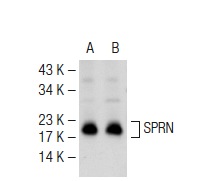
Western blot analysis of SPRN expression in rat hippocampus (A) and rat brain (B) tissue extracts.| Product Name | SPRN Antibody (S-12) |
|---|---|
| Antibody Type | Primary Antibodies |
| Antigen Alias | epitope mapping within an internal region of SPRN of human origin |
| Modification Notes | Prion diseases, or transmissible spongiform encephalopathies (TSEs), are manifested as genetic, infectious or sporadic lethal neurodegenerative disorders involving alterations of the prion protein (PrP). Constitutively expressed in normal adult brain, cellular PrP (PrP(C)) is sensitive to proteinase K digestion and is converted to the disease form, PrPSc, through alterations in protein folding conformation, which make it resistant proteases. SPRN (shadow of prion protein), also known as SHO or SHADOO, is a 151 amino acid cytoplasmic protein that is mainly expressed in brain. SPRN is considered a prion-like protein that has PrP(C)-like neuroprotective activity and may act as a modulator for the biological actions of normal and abnormal PrP. In humans, mutations in the gene encoding SPRN may be associated with variant and sporadic Creutzfeldt-Jakob disease, a degenerative neurological disorder that is incurable and invariably fatal. |
| Clonality | Polyclonal |
|---|---|
| Isotype | IgG |
| Host Species | Rabbit |
| Tested Applications | WBIPIFELISA |
| recommended for detection of SPRN of human and rat origin by WB, IP, IF and ELISA: |
|
| Species Reactivity | HumanMouseRat |
| Concentration | 1mg/ml |
| Purification | Affinity purified |
| Alternative Names | epitope mapping within an internal region of SPRN of human origin |
|---|---|
| Tissue Specificity | epitope mapping within an internal region of SPRN of human origin |
| Entrez Gene | 503542 |
|---|
Application
Western blot analysis of SPRN expression in rat hippocampus (A) and rat brain (B) tissue extracts.| Application Notes | recommended for detection of SPRN of human and rat origin by WB, IP, IF and ELISA: |
|---|
| Form | Liquid |
|---|---|
| Storage Instructions | For short-term storage, store at 4° C. For long-term storage, aliquot and store at -20ºC or below. Avoid multiple freeze-thaw cycles. |
| Storage Buffer | phosphate buffered saline , pH 7.4, 150mM NaCl, 0.02% sodium azide and 50% glycerol. |


