Application
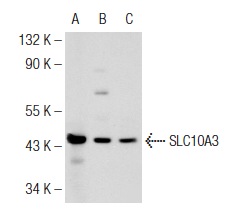
Western blot analysis of SLC10A3 expression in mouse liver tissue extract (A) and RAW 264.7 (B) and C2C12 (C) whole cell lysates.| Product Name | SLC10A3 Antibody (Q-12) |
|---|---|
| Antibody Type | Primary Antibodies |
| Antigen Alias | epitope mapping near the C-terminus of SLC10A3 of human origin |
| Modification Notes | The SLC10 family of sodium/bile salt cotransporters contains over 50 members in animal, plant and bacterial species. SLC10A3 (solute carrier family 10 (sodium/bile acid cotransporter family), member 3), also known as P3 or DXS253E, is a 477 amino acid multi-pass membrane protein belonging to the sodium:bile acid symporter family. A few members of the sodium:bile acid symporter family, such as NTCP (also known as SLC10A1) and Asbt (also known as SLC10A2), are involved in maintaining enterohepatic circulation of bile acids by mediating the first step of active bile transport through membrane barriers of liver and intestine. Other family members, including SLC10A6, play an important role in the cellular delivery of specific prohormones in testis, placenta, adrenal gland and other peripheral tissues. Family members such as SLC10A3 are uncharacterized and their functions are unknown. SLC10A3 is encoded by a gene located on human chromosome Xq28. |
| Clonality | Polyclonal |
|---|---|
| Isotype | IgG |
| Host Species | Rabbit |
| Tested Applications | WBIPIFELISA |
| recommended for detection of SLC10A3 of mouse, rat and human origin by WB, IP, IF and ELISA non cross-reactive with other SLC10A family members also reactive with additional species, including canine, bovine and porcine: |
|
| Species Reactivity | HumanMouseRat |
| Concentration | 1mg/ml |
| Purification | Affinity purified |
| Alternative Names | epitope mapping near the C-terminus of SLC10A3 of human origin |
|---|---|
| Tissue Specificity | epitope mapping near the C-terminus of SLC10A3 of human origin |
| Entrez Gene | 8273 |
|---|
Application
Western blot analysis of SLC10A3 expression in mouse liver tissue extract (A) and RAW 264.7 (B) and C2C12 (C) whole cell lysates.| Application Notes | recommended for detection of SLC10A3 of mouse, rat and human origin by WB, IP, IF and ELISA non cross-reactive with other SLC10A family members also reactive with additional species, including canine, bovine and porcine: |
|---|
| Form | Liquid |
|---|---|
| Storage Instructions | For short-term storage, store at 4° C. For long-term storage, aliquot and store at -20ºC or below. Avoid multiple freeze-thaw cycles. |
| Storage Buffer | phosphate buffered saline , pH 7.4, 150mM NaCl, 0.02% sodium azide and 50% glycerol. |


