Application
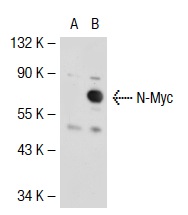
Western blot analysis of N-Myc expression in non-transfected: (A) and mouse N-Myc transfected: (B) 293T whole cell lysates.| Product Name | N-Myc Antibody (C-19) |
|---|---|
| Antibody Type | Tags Antibodies |
| Modification Notes | The v-Myc oncogene, initially identified in the MC29 avian retrovirus, causes myelocytomas, carcinomas, sarcomas and lymphomas (1), and belongs to a family of oncogenes conserved throughout evolution. In humans, the family consists of five genes: c-Myc, N-Myc, R-Myc, L-Myc and B-Myc (2). Amplification of the N-Myc gene has been found in human neuroblastomas and cell lines (3,5). The extent of N-Myc amplification correlates well with the stage of neuroblastoma disease (4). Immunological studies have shown that the human N-Myc gene encodes a nuclear phosphoprotein (2) that exhibits relatively short (30 min) half life in vivo. The prototype member of the family, c-Myc p67, binds DNA in a sequence-specific manner subsequent to dimerization with a second basic region helix-loop-helix leucine zipper motif protein, designated Max (5-7). |
| Clonality | Polyclonal |
|---|---|
| Isotype | IgG |
| Host Species | Rabbit |
| Tested Applications | WBIPIFELISA |
| recommended for detection of N-Myc of mouse, rat and human origin by WB, IP, IF and ELISA also reactive with additional species, including equine, canine, bovine, porcine and avian | |
| Species Reactivity | HumanMouseRat |
| Concentration | 1mg/ml |
| Purification | Affinity purified |
| Alternative Names | epitope mapping within the C-terminus of N-Myc of human origin |
|---|---|
| Tissue Specificity | epitope mapping within the C-terminus of N-Myc of human origin |
| Entrez Gene | 4613 |
|---|
Application
Western blot analysis of N-Myc expression in non-transfected: (A) and mouse N-Myc transfected: (B) 293T whole cell lysates.| Application Notes | recommended for detection of N-Myc of mouse, rat and human origin by WB, IP, IF and ELISA also reactive with additional species, including equine, canine, bovine, porcine and avian |
|---|
| Form | Liquid |
|---|---|
| Storage Instructions | For short-term storage, store at 4° C. For long-term storage, aliquot and store at -20ºC or below. Avoid multiple freeze-thaw cycles. |
| Storage Buffer | phosphate buffered saline , pH 7.4, 150mM NaCl, 0.02% sodium azide and 50% glycerol. |


