Application
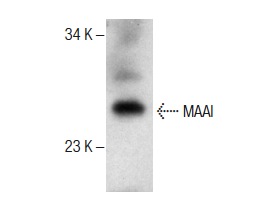
Western blot analysis of MAAI expression in human liver tissue extract.Application
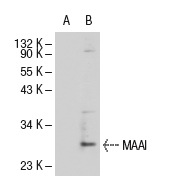
Western blot analysis of MAAI expression in non-transfected: (A) and mouse MAAI transfected: (B) 293T whole cell lysates.| Product Name | MAAI Antibody (FL-216) |
|---|---|
| Antibody Type | Primary Antibodies |
| Modification Notes | In humans, maleylacetoacetate isomerase (MAAI, also known as GSTZ1-1) catalyzes the conversion of maleylacetoacetate to fumarylacetoacetate, the fifth step in the phenylalanine/phenylacetate degradation pathway (1-3). Deficiencies in other steps of this pathway cause metabolic diseases, including type I tyrosinemia and phenylketonuria (4,5). The glutathione S-transferases (GSTs) are found in all aerobic organisms and catalyze the conjugation of glutathione to a wide variety of electrophilic substrates (1). By sequence alignment and phylogenetic analysis, a new subgroup of GST-like proteins from human, C. elegans, and carnation were identified (2). Human MAAI is 38% and 49% identical to the carnation and C. elegans proteins, respectively (2). Recombinant human MAAI is a dimer. The enzyme exhibits limited activity with known GST substrates (2). Western blot analysis indicates that MAAI is most abundant in liver, with lower levels detected in skeletal muscle and brain (2). The gene which encodes MAAI maps to human chromosome 14q24.3 (3). |
| Clonality | Polyclonal |
|---|---|
| Isotype | IgG |
| Host Species | Rabbit |
| Tested Applications | WBIPIFELISA |
| recommended for detection of MAAI of mouse, rat and human origin by WB, IP, IF and ELISA also reactive with additional species, including equine, canine, bovine and porcine | |
| Species Reactivity | HumanMouseRat |
| Concentration | 1mg/ml |
| Purification | Affinity purified |
| Alternative Names | epitope corresponding to amino acids 1-216 representing full length MAAI of human origin |
|---|---|
| Tissue Specificity | epitope corresponding to amino acids 1-216 representing full length MAAI of human origin |
| Entrez Gene | 2954 |
|---|
Application
Western blot analysis of MAAI expression in human liver tissue extract.
Application
Western blot analysis of MAAI expression in non-transfected: (A) and mouse MAAI transfected: (B) 293T whole cell lysates.| Application Notes | recommended for detection of MAAI of mouse, rat and human origin by WB, IP, IF and ELISA also reactive with additional species, including equine, canine, bovine and porcine |
|---|
| Form | Liquid |
|---|---|
| Storage Instructions | For short-term storage, store at 4° C. For long-term storage, aliquot and store at -20ºC or below. Avoid multiple freeze-thaw cycles. |
| Storage Buffer | phosphate buffered saline , pH 7.4, 150mM NaCl, 0.02% sodium azide and 50% glycerol. |


